global warming

global warming

global warming

A report estimates that there are three years of carbon budget left to achieve a 1.5 °C increase

The carbon available for emission without exceeding the 1.5°C limit set in the Paris Agreement—known as the carbon budget—could be exhausted in just over three years at the current rate of CO2 emissions. This is one of the conclusions of a new edition of Indicators of Global Climate Change, published in the journal Earth System Science Data. The study also shows that between 2019 and 2024, sea levels rose by an average of around 26 millimetres: more than double the rate of 1.8 mm per year recorded since the beginning of the 20th century.

0

Review the dangers of climate change for plants and the possibilities for adaptation

The changes caused by the climate crisis—such as its impact on rainfall and rising temperatures—are stressful for plants in both wild and agricultural environments. A special issue of the journal Science brings together five articles reviewing this issue, including the adaptations that plants can adopt and that could be applied to combat it.

0

Climate change is increasing sudden temperature changes

An international team has analyzed the sudden changes in temperature that occurred in the world between 1961 and 2023. Their conclusions are that more than 60% of the regions included in the analysis - including Western Europe - have experienced an increase in the frequency and intensity of these sudden changes, which can endanger health, agriculture or infrastructures. Moreover, the trend will continue to rise as a result of climate change. The results are published in the journal Nature Communications.

0

Loss of Arctic sea ice could increase humidity in Spanish and Portuguese winters

A study led by ISGlobal researchers has analysed how the loss of Arctic sea ice influences climate in isolation from other factors related to climate change. Their results, published in the journal Communications Earth and Environment, show that, on a time scale of decades, the loss of Arctic sea ice favours a drier climate in the southwestern United States -in particular in California-, especially in winter. This phenomenon would also affect the climate of Spain and Portugal, leading to wetter conditions in winter, although the effect is weaker.

0

The increase in emissions could halve the maximum limit of satellites that orbit the Earth safely

The maximum number of artificial satellites that can safely orbit the Earth could be reduced due to the increase in greenhouse gas emissions of human origin, according to a modelling study. The increase in these gases may result in a reduction in the density of the planet's orbital space. Between 2000 and 2100, the carrying capacity of satellites between 200 and 1,000 kilometres altitude could be reduced by between 50 and 66%, estimates the study published in Nature Sustainability.

0

Long periods of extreme heat could increase the biological age of older people by more than two years

Research has analyzed how extreme heat influences the biological age of elderly populations, specifically in the United States. The study, published in Science Advances, used blood samples from more than 3,600 adults with an average age of 68 collected between 2010 and 2016. The team compared epigenetic aging trends with the number of days of extreme heat in the participants' places of residence. The models showed that more days of heat or long-term heat — over a period of one to six years — increased the biological age of the participants by more than two years.

0

Assessing the impact of the 1.5°C rise in 2024 on the Paris Agreement goals

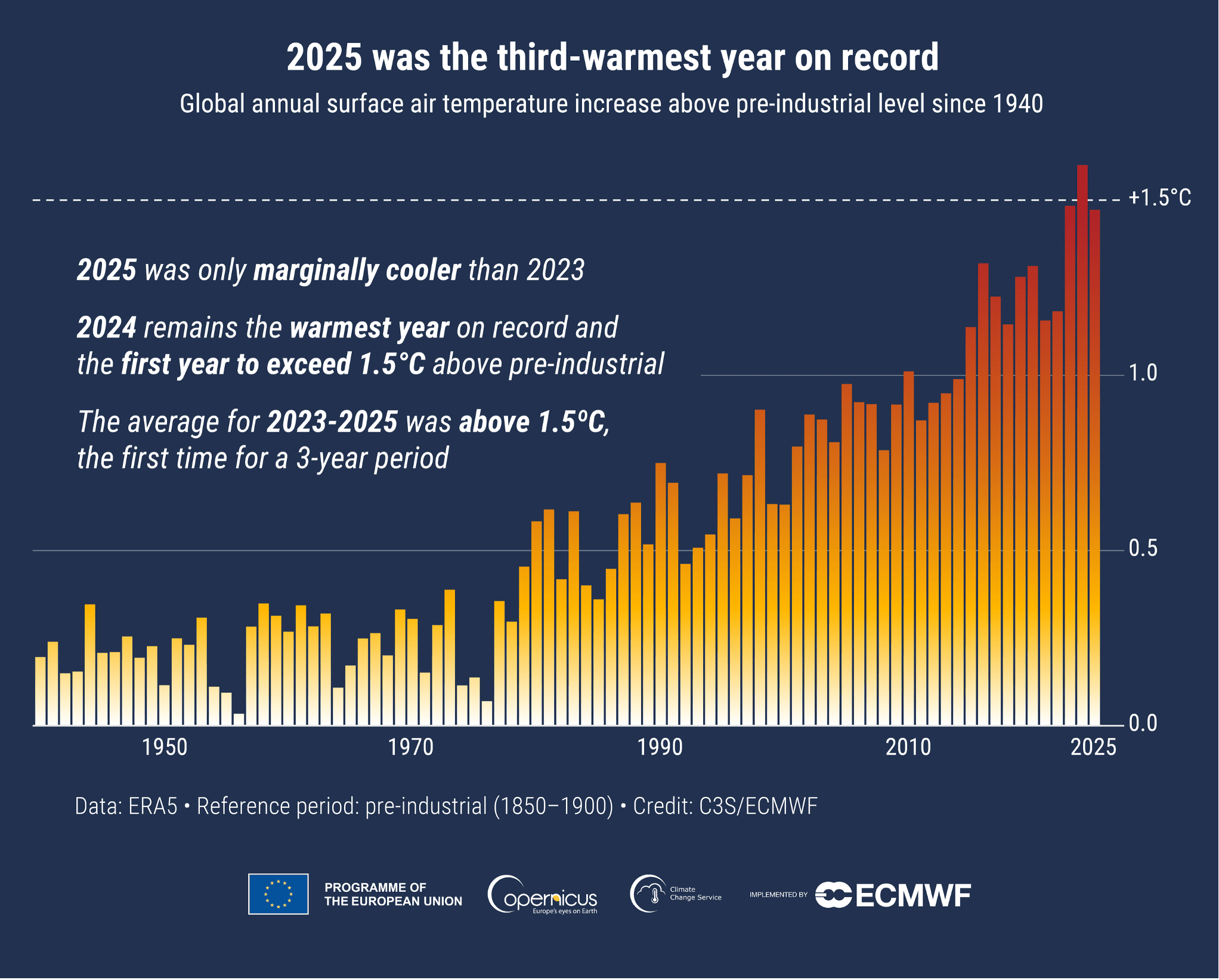
Two papers published in Nature Climate Change analyse the possibility of exceeding the Paris Agreement targets of limiting warming to 1.5°C above pre-industrial temperatures. Both papers suggest that having exceeded this warming threshold by 2024 could indicate that we have entered a period of several decades with average global warming of 1.5 °C. According to the authors, rigorous climate mitigation efforts are needed to keep the Paris Agreement targets within reach.

0

Fossil CO2 emissions to rise to 37.4 billion tonnes by 2024, says major carbon balance report

There are still no clear signs that global fossil carbon dioxide (CO2) emissions have peaked, according to the 2024 Global Carbon Budget. The report - which is published in the journal Earth System Science Data in preprint format and will be launched at COP29 in Baku - estimates that these emissions will grow by 0.8% this year compared to 2023, to 37.4 billion tonnes of CO2. If this rate continues, there is a 50% chance that global warming will exceed the 1.5°C limit in six years.


0