Only 54% of electronic waste is collected correctly in Europe
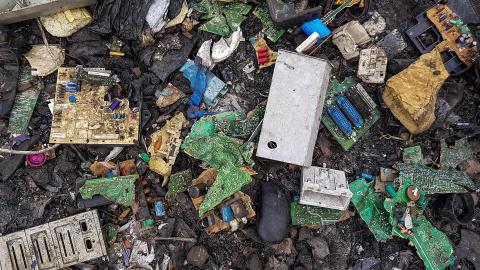
In 2050, the total volume of waste electrical and electronic equipment in Europe will reach between 12.5 and 19 million tonnes, compared to 10.7 million tonnes – around 20 kilograms per person – in 2022, according to the report 2050 Critical Raw Materials Outlook for Waste Electrical and Electronic Equipment. Of this volume, only 54% was collected and treated correctly in 2022. Furthermore, of the one million metric tonnes of critical raw materials such as copper, aluminium and silicon present in this waste, less than half was successfully recovered, according to the report's estimates.
251014 residuos jorge EN
Jorge Torrubia Torralba
Material Systems Research Analyst at the British Geological Survey
The report 2050 Critical Raw Materials Outlook for Waste Electrical and Electronic Equipment in the European Union plus Iceland, Norway, Switzerland and the United Kingdom is the result of the Futuram project, successor to the now completed ProSUM project, which, together with the reports of the Global e-waste Monitor, constitute the most detailed and comprehensive studies on electronic waste (WEEE), both at European (Prosum and Futuram) and global (Global e-waste monitor) levels.
All of them divide electrical and electronic equipment (EEE) into the so-called UNU-Key categories. This categorisation is based on the similarity of the equipment in terms of: function, material composition, average weight and recycling characteristics. This results in 54 different categories according to key characteristics for the analysis of the circular economy. This categorisation is more extensive and appropriate than the six categories in the European regulations (temperature exchange equipment, displays, lighting equipment, large appliances, small appliances and telecommunications equipment) and the seven in the Spanish regulations, which has one more because it considers photovoltaic panels separately, which are included in the large appliances category. Thus, each UNU-Key is subdivided into component (EEE units, e.g. a computer hard drive), material (e.g. steel or copper alloys) and element (e.g. iron, copper or tin). All of the above reasons (key characteristics for the circular economy, the scope and comprehensive identification of materials) make this methodology the most robust to date.
This report shows the current state of the circular economy for EEE in the European Union, the United Kingdom, Iceland, Norway and Switzerland. The methodology makes it possible to identify critical raw materials (CRMs) that are currently lost or recovered, and establishes strategies to improve their recovery in the future. CRMs are identified according to two parameters: their economic importance to states and the risk of supply of these raw materials to states. As a result, CRMs are vital to the functioning of the economy and key sectors such as energy and defence. The results of the study show that 46% of CRMs are lost because WEEE is not collected properly. In addition, approximately 20% of the 54% that is collected through the appropriate channels is also lost during recycling. These figures show the enormous scope for improvement in the recovery of CRMs from WEEE. Furthermore, the study detects an upward trend in EEE placed on the market in the future, especially those containing more CRMs.
The study therefore recommends: improving collection rates, improving dismantling, identifying components containing CRM and improving policies to promote the economic conditions for CRM. These measures are key to CRM recovery, which would establish new industries with the consequent generation of employment, improve European independence from CRM imports and, potentially, avoid primary mining and its negative environmental consequences. These last two advantages would only occur if the demand for CRMs did not increase in the future. Therefore, another key additional recommendation would be to increase the useful life of products to try to contain the growing demand for CRMs.
Finally, I think it is important to point out two aspects regarding this report. On the one hand, the importance of the public availability of this data for research and for companies. In previous ProSUM reports, not all the information collected by the project was publicly available, particularly in terms of the level of detail needed to understand the composition of WEEE. This limits the possibilities for researchers and companies when it comes to launching projects for the recovery of RCMs. On the other hand, this study only considers CRMs present in EEE. This amount is quite limited, since vehicles, batteries, renewable energy installations and even tailings (waste) from operating or abandoned mines can be much more significant sources of CRMs. However, the variety of CRMs offered by WEEE compared to other secondary sources should not be overlooked.
251014 residuos martin EN
Martín Muñoz Morales
Professor and researcher in the field of Chemical Engineering at the School of Agricultural Engineering, Forestry and Biotechnology at the University of Castilla-La Mancha
The FutuRaM project report has made a great effort to compile information and predict the quantification of electronic equipment (EEE) and the subsequent waste generated (WEEE) at the end of its useful life (2022-2050).
This study is particularly interesting due to the relevance of these materials and their commercial scarcity within the European Union. The three future scenarios established—common commercial scenario, recovery scenario, and circularity scenario—should make us reflect on how to avoid dramatic situations and waste of resources.
The high demand for these critical metallic materials, together with the costly recovery process and the need to develop innovative technologies for this purpose, must be understood by society so that this third scenario, with a high percentage of circularity, can be implemented.
In this way, extending the useful life of products containing these elements, together with the development of technology for their recovery, would promote a reduction in available waste and a high percentage of recovery.
The scenario presented in this report indicates the need to recover metals, especially critical ones, using sustainable technology that must be developed in an economical manner and with low environmental impact. It also highlights the need for technological development (and a research budget for this purpose) in this area and the importance of involving companies and end users in order to improve the recycling process.
Conflict of interest: "I am currently part of the research team in the GEOCENTRIC project (integration of the circular economy in the decontamination and recycling of waste with high metal content), jointly funded by regional funds from the European Union and the JCCM through the CLM Research and Innovation Agency (INNOCAM)".
251014 residuos JJulian EN
José Julián Escario Gracia
Lecturer at the Faculty of Business and Public Management of the University of Zaragoza in Huesca
The FutuRaM – 2050 Critical Raw Materials Outlook report on electrical and electronic waste is part of the European FutuRaM project, funded by the Horizon Europe programme. Its main objective is to assess the future demand and availability of critical raw materials, as well as recycling and recovery rates in six categories of waste electrical and electronic equipment (WEEE) — including refrigeration appliances, small equipment (microwaves, toasters, radios, electronic cigarettes, etc.), screens and monitors, etc.—in order to support data-driven policies to strengthen the European Union's material autonomy and circular economy.
The report is implemented in the EU27, Iceland, Norway, Switzerland and the United Kingdom (EU27+4). The study is based on a robust and standardised methodology, using stock and flow models applied individually to the EU27+4 countries. The model integrates data observed up to 2022 and projections up to 2050 under three scenarios: the current scenario, a recovery scenario and a circular economy scenario. Harmonised databases from official statistics, scientific literature and verified waste samples are used to simulate losses and recoveries at each stage of treatment, giving the report a high degree of technical reliability.
In 2022, 10.7 million tonnes (Mt) of electrical and electronic waste were generated in the EU27+4, containing 1 Mt of 29 critical raw materials, such as copper, aluminium, neodymium and palladium. Currently, only 54% of electrical and electronic waste is collected and recycled appropriately. By 2050, electronic waste is expected to increase to between 12.5 and 19 Mt depending on the scenario considered, and critical raw materials to between 1.2 and 1.9 Mt.
The FutuRaM approach extends the framework of the ProSUM project and the WEEE and Critical Raw Materials Directives, incorporating for the first time long-term modelling (2010–2050) and a common methodology applicable to various waste streams.
The integration of the results into the Urban Mine Platform digital platform represents a key innovation, as it allows critical material “hot spots” to be visualised and facilitates industrial and political decision-making. Among the main limitations, the report estimates the “theoretical availability” of critical materials, without assessing actual recovery in end-of-life plants.
Furthermore, batteries are excluded from the dataset and a uniform product composition across Europe is assumed, which could mask national variations.
The study is highly relevant for Spain, a country with a growing volume of WEEE and a low recovery rate of strategic materials.
The main recommendations of the study are:
- Strengthen the selective collection and traceability of WEEE.
- Encourage eco-design of products to facilitate repair and disassembly.
- Invest in technologies for the separation and refining of elements such as rare earths and platinum group metals.
Overall, FutuRaM provides a solid basis for guiding European resource and circular economy policy until 2050, positioning electronic waste as a key pillar for the EU's material independence.
251014 residuos patricia ES
Patricia Córdoba Sola
Industrial pollution researcher, member of the Environmental Geochemistry and Atmospheric Research group (EGAR)
The report is an outstanding and comprehensive study evaluating the generation of waste electrical and electronic equipment (WEEE) and the associated flows at the end of its life cycle in Europe. It is based on the FutuRaM project, which provides the guidelines and methodological basis necessary for this purpose. Although the approach is rigorous and technically sound, some model assumptions, such as uniformity in product composition or theoretical estimates of critical raw material recovery, could limit the ability of these models to reflect the practical reality of WEEE generation and management in the different EU27+4 countries.
Firstly, the report presents key definitions of what is considered WEEE, its classification and the applicable regulations, in particular the European Directive, and includes numerical data on WEEE generation and recovery rates, based on the Global E-waste Monitor 2024. However, this introduction could have been enriched with an analysis of the causes behind the low recovery rates observed.
The core of the FutuRaM approach is the application of a stock and flow model, which quantifies the main statistical indicators of WEEE from its introduction on the market, through its active use phase, to its transition to end-of-life flows. By linking product composition data with WEEE flows and different recovery pathways, the model provides a balanced understanding in terms of mass of theoretical availability and losses of secondary raw materials over a time horizon extending to 2050. This offers valuable insights for optimising WEEE stream management, meeting future resource needs, reducing waste and promoting circularity in the EU27+4.
The FutuRaM methodology is based on a solid conceptual framework, aligned with international standards such as those of the UNECE (2022) and the E-waste Statistics Guidelines (Forti et al., 2018). Its structure integrates multiple analytical dimensions, from product composition to prospective waste management scenarios, providing a systemic and dynamic view of WEEE flows in Europe.
A notable element is the expansion of product characterisation through the hierarchical approach of the ProSUM project (European Commission, 2023), which allows products to be disaggregated according to UNU-KEY codes and their composition to be structured into mutually exclusive levels of components, materials and elements. This hierarchy improves the traceability and understanding of the distribution of critical raw materials, providing a greater level of technical detail to the model. However, this refinement coexists with a simplifying assumption: the uniformity of product composition across the EU27+4, which could limit the model's ability to reflect real differences between countries in consumption, technological structure, product availability or national recycling policies.
The flow model combines official data with the Weibull distribution to estimate WEEE generation, demonstrating a solid and consistent methodological basis; however, it would have been beneficial to explain the integration criteria in more detail in order to fully assess the traceability of the model. For its part, the waste composition modelling integrates the historical and technological evolution of products, allowing the composition of WEEE to reflect the mix of successive generations of appliances, which reinforces the representativeness of the analysis.
The recovery model provides theoretical estimates of the availability of critical raw materials, preserving the product-component-material-element hierarchy and applying transfer coefficients at each stage of treatment. It is a robust model for simulation and planning, but it does not incorporate unforeseen operational losses or constraints associated with product design.
Regarding future scenarios up to 2050, the model projects three possibilities:
- Business-as-usual (BAU): maintains current trends in consumption and WEEE generation.
- Recovery (REC): improves waste recovery without altering generation.
- Circularity (CIR): incorporates the circular economy, with more durable and repairable products and lower quantities of WEEE.
While these scenarios allow for the exploration of long-term impacts, their results depend on assumptions about consumption, product design and recovery efficiency.
Finally, the report highlights the need to improve the collection and recovery of critical materials, identifying significant losses during collection and emphasising the importance of improvements in product design and recovery technologies to maximise the availability of these materials.
251014 residuos nicolás EN
Nicolás Villanueva Martínez
Postdoctoral researcher at the Joint University Institute for Energy and Resource Efficiency of Aragón (ENERGAIA - UNIZAR)
The FUTURaM project is the most detailed analysis to date on secondary raw materials from Waste Electrical and Electronic Equipment (WEEE). It focuses on the availability of elements that constitute critical and strategic raw materials from WEEE, making a projection from the present to the year 2050 and considering three scenarios: “business as usual” (BAU), in which current consumption trends and recovery and recycling rates continue; “enhanced recovery” (REC), in which consumption patterns follow current trends, but waste collection rates and recycling technologies are improved; and “circularity” (CIR), in which, in addition to improving collection and recycling rates, circular economy measures are applied to reduce WEEE consumption and, therefore, waste generation (such as extending useful life, improving second-hand markets or promoting repair, among others). Data on WEEE generation and collection are obtained from statistics provided by Eurostat and reports from various countries in the EU+4 (United Kingdom, Switzerland, Iceland and Norway), as well as scientific literature.
One of the most important current data points in the report is that WEEE generation reaches 10.7 million tonnes per year in the 27+4, of which only 5.7 are collected by the appropriate channels that allow for proper recycling. The rest is collected by other methods (such as household waste), mixed with other waste, exported to middle- and low-income countries, or its whereabouts are unknown. These 10.7 million tonnes in the countries studied correspond to 20 kg per person, the same as in Spain. Under the BAU and REC scenarios, per capita generation is expected to reach 36 kg per year by 2050. However, by applying circular economy measures (CIR scenario), this can be reduced from 2040 onwards to less than 25 kg per person per year (both for Spain and for the 27+4) by 2050. These results are consistent with those obtained in the research study Alargascencia: Environmental benefits of extending the useful life of mobile phones and laptops in Spain, where we also showed that extending the useful life of EEE can be as effective a strategy for reducing waste as increasing recycling rates. It should be noted that the waste that will increase the most will be that from solar panels.
One of the most significant difficulties in assessing the availability of raw materials from secondary sources (such as WEEE) is knowing their chemical composition. For some appliances, such as lamps, this is more or less standard, but for others, such as mobile phones or computers, it can vary from one manufacturer or model to another. Manufacturers do not tend to share this information, and the data in the literature is limited. The FUTURaM project has addressed this problem by drawing on the results of previous European projects, data from the literature and confidential consultations with project partners and stakeholders, which provides a solid basis. However, it should be noted that compositions may vary over the years and, while projections can be made, it is impossible to know exactly how they will evolve in the future. One example is the amount of gold present in smartphones and laptops, which has been decreasing in recent years. The same is true of technologies; it is impossible to know when a technology will appear that will render a previous one obsolete. For example, CRT televisions were quickly replaced by plasma, LCD and LED televisions. Similarly, between now and 2050, new photovoltaic cell technologies may emerge to replace the current crystalline silicon ones.
With regard to the elements that can be recovered from WEEE, aluminium and copper stand out in particular, accounting for 87% of the mass of critical raw materials available in WEEE. These two elements can be recovered quite efficiently through recycling processes, so encouraging waste collection is an efficient measure to increase their production from secondary sources. Manganese and silicon are similar cases. However, other critical raw materials that are very important in the European context, such as neodymium (essential for permanent magnets) and cobalt, are very difficult to recycle from WEEE in the current context. This situation highlights the importance of eco-design, which allows devices to be manufactured in such a way that their parts, components and materials can be disassembled, sorted and separated more efficiently, increasing the recyclability rate of metals.
This study highlights, on the one hand, the great opportunity that Europe has with WEEE to access critical raw materials on which it is heavily dependent on imports. On the other hand, it points to the need to improve collection processes and increase the proportion of WEEE that is managed correctly in accordance with European regulations. Finally, it also shows that true circularity requires not only increasing collection and recycling rates, but also measures aimed at reducing consumption and waste of resources, such as increasing the useful life of products, eco-design, promoting repair and second-hand markets, among others.
G. Iattoni et al. United Nations Institute for Training and Research, Technische Universität Berlin, WEEE Forum.
- Report
- Non-peer-reviewed