COP31 fails to reach an agreement due to a lack of ambition – something that has not happened for almost twenty years
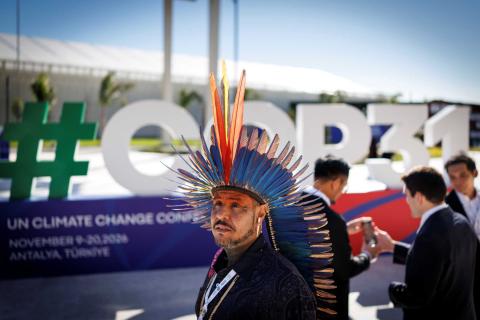
The climate summit in Antalya (Turkey), the longest in the history of the COPs, has failed to reach a consensus agreement – something that has not happened since the 2009 Copenhagen summit. Co-chaired by Australia, and following more than two weeks of negotiations, the nearly 200 delegations have been unable to agree on the final text. The document made no direct mention of phasing out fossil fuels, as called for by the EU and other parties, but did advocate carbon capture and storage technologies – championed by oil-producing nations and other countries, yet heavily criticised for their high cost and because they do not lead to a reduction in CO2 emissions. The COP presidency has stated that there will be no new draft.
Alicia Pérez Porro - COP31 acuerdo EN
Alicia Pérez-Porro
Marine biologist, responsible for policy interaction and institutional relations at the Centre for Ecological Research and Forestry Applications (CREAF) who has been to Antalya
It is certainly not good news that no agreement has been reached on a final text, not so much because of the omission of any reference to fossil fuels or a new financing target – which we already knew would be very difficult, if not impossible, but also because of the message it sends to the world that multilateralism is in decline and that it is difficult to reach a consensus to move forward at the pace required to implement the Paris Agreement and meet the most ambitious targets for tackling the climate emergency.
On the other hand, the most important aspect of this COP was not the final text. This is a sort of recent trend whereby all host countries want the name of the organising city or country to be enshrined in some agreement, such as the Paris Agreement; they want to go down in history, so to speak. But in reality, COPs do not necessarily have to produce these final texts; some do, but not all, and what really matters are the decisions on implementation.
This COP, which was very aptly dubbed the ‘COP of implementation’, was significant in that it broke the deadlock on those decisions that allowed us to continue making progress on the implementation of the Paris Agreement. In this regard, there are some decisions that have indeed been approved and adopted, such as the NAPs – the National Adaptation Plans, for example. But then there are other decisions that have been kicked down the road and passed on to COP32. That is where I see the greater risk and problem, rather than simply the fact that a final text has not been approved. This accumulation of decisions that have not been taken also implies a deadlock in this race towards the implementation of the Paris Agreement. This slows down the whole process, and we are not at a stage where we can afford to move any slower. On the contrary, we should be moving faster. Another thing demonstrated by this lack of final consensus at COP31 is the lack of ambition.
From here on, we have no choice but to continue working towards multilateralism and keep pushing forward; and those countries that do have the ambition – such as Spain, which is a country that does have that ambition right now – must continue to lead the way. We simply cannot afford to do otherwise. And looking to the future, we must also work at other levels: at sub-national level, at national level, and ensure that this negative outcome does not discourage us or lead to inaction. And by ‘people’, I mean governments.
Carlos de Miguel - COP31 acuerdo EN
Carlos de Miguel Perales
Environmental Lawyer and Lecturer of Civil and Environmental Law at ICADE Law School (Comillas Pontifical University)
COP31 has concluded without a consensus text. A common criticism of past COPs has been a lack of ambition. In this case, paradoxically, the absence of a final text shows that a significant part of the international community is not giving up on its ambition – and rightly so. Admittedly, this comes at the expense of multilateralism, which has suffered a major blow today. But, as always, we must try to remain positive: it is to be hoped that this lack of consensus will act as a wake-up call for COP32; that it will be one step back in order to take two steps forward.
Tania Guillén - COP31 acuerdo EN
Tania Guillén Bolaños
Researcher at the Climate Service Center Germany (GERICS)
COP31 was intended to be the ‘implementation’ COP, where it was necessary to establish clear guidelines for ambitious climate action that would help mitigate the impacts of climate change, which are already being observed in various regions of the world. However, the draft prepared by the presidency fell short of meeting the necessary level of ambition. The fact that countries such as Panama had set out their red lines in advance and did not accept the draft is a demonstration of multilateralism, where, on occasion, no agreement is better than a bad agreement.
This highlights the need to improve the negotiation process, so as to prioritise the demands and needs of vulnerable countries and communities, particularly as we are drawing ever closer to the limits set out in the Paris Agreement. The draft, and the negotiations in general, have failed to address the urgency of climate action. Issues such as the failure to mention the need for a transition away from fossil fuels or funding for adaptation are serious given the reality already facing many regions, such as communities in the Central American Dry Corridor.
Martin Siegert - COP31 acuerdo EN
Martin Siegert
This could be, strangely, good news for the climate process. A line has been drawn, where international agreement can only proceed if there is clear agreement that fossil fuels need to be transitioned away from as soon as possible. The science, which is so obvious, demands this. To agree to anything less would be more of a disaster than the failings of COP31. It doesn't mean the end of the COP process - but a resetting is needed so that it focuses on firm action to reduce global emissions, to transition to renewable energy and electrification, and to do all this urgently within a fair and just framework.
Daniela Schmidt - COP31 valoración EN
Daniela Schmidt
Professor of Earth Sciences, University of Bristol.
The world is witnessing accelerating impacts of climate change. Fires in places at an extent not seen before. Deady heatwaves resulting in tens of thousands of deaths in many parts of the world. Glaciers are melting causing catastrophic flash floods in the Himalayas. But this urgency is not felt by decision makers.
Thinking we can just continue, capture the CO₂ and store it, while at the same time destroying the most effective system which does exactly this for millions of years in our forests and seas is infuriating.
While there is an acknowledgement that we have surpassed 1.5°C warming relative to pre-industrial, the technologies we have are not mentioned, highlighted or supported in the discussions governments conducted over the last two weeks. We know what to do to adapt and to mitigate but there is no acknowledgement from those elected to lead us that the moment is now. The shortsightedness, thinking about the now but not about the tomorrow, is heartbreaking. And we will pay the price.
Yvonne Buckley - COP31 acuerdo EN
Yvonne Buckley
It now appears that the COP31 talks have collapsed with the fourth draft formally rejected by the EU and others including Panama, who wrote an open letter setting out their red line issues earlier in the process. The COP31 draft text fails to mention the necessity of moving away from fossil fuels as the primary cause of human induced climate change.
This COP has seen arguments around the use of the best available science; indeed, the scientific foundation of global climate agreements has been under attack. At the same time there has been acknowledgment that we have failed to meet the Paris agreement threshold of limiting warming to +1.5C. It has never been clearer that we need to act to stop the continued use of fossil fuels.
While it is disappointing that global multilateralism has failed here, perhaps failure is needed to catalyse meaningful action in the future. Ireland and Tuvalu are jointly hosting the Transition Away from Fossil Fuels initiative in 2027, which was established at the Santa Marta COP last year to enable countries serious about the transition to make progress. This has taken on new significance given the failure of COP31.
Panama's intervention sought to strengthen the support of science and the need to jointly negotiate the three UN conventions on climate, biodiversity and land degradation. Panama recognises that nature is our first line of defence in combating climate change and its impacts.
Breffní Lennon - COP31 acuerdo EN
Breffní Lennon
What is happening in Antalya is interesting on several fronts, not least it is demonstrating that words, and the use of language still matter. We have had, particularly under the Trump presidencies, a situation where words and the language of diplomacy have become largely meaningless in some circles, e.g., Trump’s meeting with Putin in Shenzhen. COP also demonstrates how complex international negotiations actually are.
The EU has done the morally correct thing, rejecting the draft text. They may have also saved consensus politics by walking away from a bad deal. If they had allowed the petrostates to highjack another COP negotiations and accepted a fudge that does not mention transitioning from fossil fuels, Global South countries and the island nations would have keenly felt the betrayal. Walking away may also finally impress upon the petrostates that they cannot keep forestalling the systemic changes that are needed as we career into climate overshoot. It cannot be business as usual anymore, the petrostates and the fossil fuel lobbies they fund have to finally get real.