neuroscience

neuroscience

neuroscience

New neurons detected forming in adult human brains

A team from Sweden has analysed post mortem brain samples from people aged between 0 and 78 using various techniques and found that, although it varies between individuals, new neurons continue to form in the hippocampus with no apparent age limit. Although previous studies had reached similar conclusions, controversy remains about these results. According to the authors, the new work ‘provides an important piece of the puzzle in understanding how the human brain works and changes throughout life.’ The results are published in the journal Science.

0

People can habituate to democratic decline

The brain can become habituated to the deterioration of democracy, warn a neuroscientist and a law expert in an editorial published in Science Advances. "When democratic norms are violated repeatedly, people begin to adapt,’ they explain, calling for a "dishabituation" to democratic decline. This requires "see[ing] things not in light of the deterioration of recent years, but in light of our best historical practices, our largest ideals, and our highest aspirations.

0

Electrical brain stimulation could improve mathematics learning in people with more difficulties

An international study with 72 participants has found that greater connectivity between certain brain areas is associated with greater mathematical computational ability. In addition, weak electrical stimulation in a particular area was associated with improved computational learning in volunteers with lower connectivity. The results are published in the journal Plos Biology.  

0

Synapses in individual neurons do not follow a single strategy during learning as previously thought

A new study sheds light on how the brain adjusts its ‘wiring’ during learning, concluding that different dendritic segments of the same neuron follow different rules for communicating through their connections - synapses. The findings challenge the idea that neurons follow a single learning strategy and offer a new perspective on how the brain learns and adapts its behaviour. The work, carried out in mice, is published in the journal Science.

0

Published a detailed map of the connections between brain cells in mice

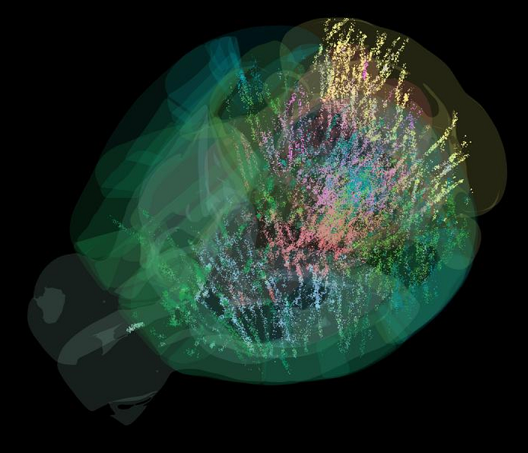
A set of articles published in Nature and Nature Methods draws a high-resolution map of the structure of and connections between the brain cells of mice. The map is based on data from a single cubic millimetre of brain and includes more than 200,000 cells, around 84,000 neurons and 524 million synaptic connections. Although this is a very small part of the mouse brain, it will help us understand how different types of cells work together.

0

Study identifies proteins linked to brain ageing

Researchers in China have analysed data from more than 4,500 people and identified 13 proteins linked to brain ageing. In addition, changes in protein concentrations in the blood tend to peak at ages 57, 70 and 78. According to the authors, who publish the results in the journal Nature Aging, these ages may reflect transitions in human brain health at specific ages, and could therefore be important for designing possible interventions in the brain ageing process.

0

Deep brain stimulation improves walking after spinal cord injury

According to a study published in Nature Medicine, deep brain stimulation of the lateral hypothalamus improves walking and promotes recovery in humans and rodents with spinal cord injuries. In humans, the authors tested this technique on two patients who relied on assistive devices and had difficulty walking; both showed improved performance in the ten-meter and six-minute walking tests. Combined with rehabilitation, the patients experienced recovery that persisted even after the deep brain stimulation was turned off.

0

Astrocytes, like neurons, would also store memories

Until now, memories have been explained by the activity of neurons that respond to learning events and control recall. A study published in Nature changes this theory by showing that non-neuronal cells in the brain called astrocytes - star-shaped cells - also store memories and work in concert with clusters of connected neurons called engrams to regulate the storage and retrieval of memories.

0

Imaging study details changes in a woman's brain during and after pregnancy

A study describes changes in a woman's brain during and after pregnancy, including a ‘pronounced’ decrease in grey matter volume and cortical thickness, and an increase in ventricular volume and cerebrospinal fluid. Some of the changes are maintained in the postpartum period; others reverse within months. The team performed 26 MRI scans and blood tests on one mother, from pre-conception until two years postpartum, and publish the results in Nature Neurology

0