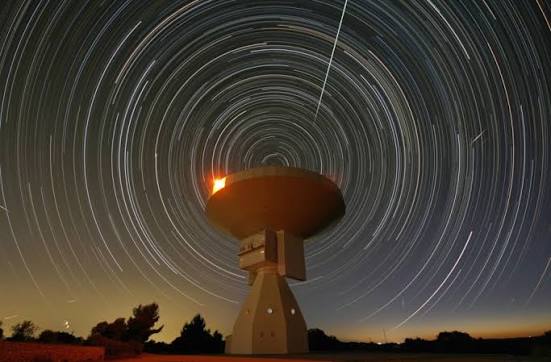
Sugar has been detected in interstellar space by the radio telescopes at Yebes in Guadalajara and Pico Veleta in the Sierra Nevada
A team led by a Spanish researcher has identified, near the centre of the Milky Way, a type of sugar composed of four carbon atoms, known as erythrulose, which on Earth is found in raspberries and self-tanning products. This would suggest that complex and biologically relevant molecules can form in space. Ribose and glucose had previously been discovered in samples from meteorites and asteroids, but until now no sugar had been directly detected in the interstellar medium. The finding is published in Nature Astronomy.
Emilio Martínez Núñez - azúcar espacial
Emilio Martínez Núñez
Finding a sugar in the interstellar medium may seem impossible. However, an international team has succeeded in detecting a sugar in space for the first time: erythrulose, a four-carbon monosaccharide, in a molecular cloud situated near the centre of our galaxy, known as G+0.693−0.027. How is it possible to identify a molecule at such an enormous distance? Just like a fingerprint, every molecule has a distinctive signature that allows it to be identified. In this case, that signature is its rotational spectrum: the set of microwave frequencies associated with the molecule’s rotation and characteristic of each molecular structure. To identify erythrulose, it was essential to first obtain this spectrum in the laboratory.
This was a considerable challenge, as this molecule readily absorbs water from the environment and decomposes when heated. The authors overcame this difficulty using an innovative vapourisation technique involving ultrafast laser pulses, which enabled them to record its rotational spectrum in the gas phase for the first time. The identification was corroborated by quantum chemical calculations and astrochemical models showing a chemically plausible formation pathway on the ice coatings of interstellar dust grains. Surprisingly, erythrulose is at least eight times more abundant than similar three-carbon sugars, which were not detected despite the study’s extremely high sensitivity.
It should be noted that this does not imply that erythrulose reached Earth or played a role in the origin of life; its significance lies in demonstrating that interstellar chemistry can generate molecules of increasing complexity, by combining astronomical observation, laboratory spectroscopy and theoretical chemistry.
Andrés de la Escosura Navazo - azúcar espacial
Andrés de la Escosura Navazo
Researcher at the Institute for Advanced Research in Chemical Sciences (IAdChem) and in the Department of Organic Chemistry at the Autonomous University of Madrid (UAM), director of the Biohybrid Materials and Systems Chemistry research group.
The authors of this article describe, for the first time, the detection of a sugar, erythrulose, in interstellar space. To date, astrochemical methods had enabled the detection of more than 340 molecules of varying size and molecular complexity, but sugars with three or more carbon atoms had remained undetected. This stood in contrast to the importance that this family of compounds holds in modern biochemistry, as metabolic fuels and components of nucleic acids, and presumably in the chemistry that led to the origin of life. Essential sugars such as ribose and glucose had also been detected in meteorites and on the asteroid Bennu, suggesting that an abundant source of these building blocks of life was exogenous—that is, not generated on Earth but originating from outside the planet via meteorite impacts approximately 4,450 to 3,900 million years ago. However, it was not clear how the sugars in these celestial bodies had been formed. The study now published sheds some light on their formation within the icy dust grains found in interstellar space, more specifically in a central region of the galaxy that is particularly rich in organic compounds. At a later stage in their cosmic evolution, these dust grains would aggregate to form asteroids, planetesimals and protoplanets.
The study, which not only involves spectroscopic analyses using data from radio telescopes but also computational calculations to understand the mechanism by which erythrulose forms under these conditions, as well as modelling the evolution of this and other sugars in interstellar space, is significant for several reasons. Firstly, because of the leap in complexity that has been made in the types of molecules that can be detected using these methods.
Until recently, it was only possible to detect one- and two-carbon biomolecules, which are still a long way from the structural complexity observed in metabolism. In this regard, although the detection of five- and six-carbon sugars would be far more significant from a biochemical perspective, this finding suggests that it might be possible if they are out there.
Furthermore, identifying mechanisms for the formation of sugars that are alternative to the known prebiotic methods—primarily the Formose reaction, which takes place in an aqueous medium—could help overcome some of the problems posed by the latter: specifically, that it does not produce ribose, the sugar essential for RNA formation. This problem has long been a constraint on the RNA world hypothesis, and to date there is no satisfactory solution.
All in all, there is still a very long way to go before we can fully understand, in all its complexity, the process by which a more or less diverse set of molecules led to the first populations of protocellular systems capable of self-sustaining, reproducing and evolving. Finding some of these basic molecular components in space is undoubtedly an important step in that direction.
César Menor Salván - azúcar espacial
César Menor Salván
Astrobiologist and lecturer of Biochemistry at the University of Alcalá
The first thing to note is that this work does not solve the problem of the origin of life or the origin of molecules such as DNA or RNA. We must be very careful about drawing conclusions, but it is a novel, highly significant and extremely interesting discovery.
It is an extraordinary piece of work that combines radio astronomy, molecular spectroscopy and computational chemistry, confirming the detection of a sugar molecule, erythrulose. The origin of sugars is one of the problems to be resolved in the origin of life, and their detection in interstellar space shows us two things: firstly, that they can form under natural conditions in space. Secondly, that it may support the hypothesis that these molecules, accumulated and preserved in ice, could have released these sugars into environments conducive to the origin of life, such as the early Earth.
Furthermore, erythrulose forms part of a family of sugars, known as ketoses, which are particularly stable; we believe they played a key role in the process of chemical evolution leading to life and are, in my opinion, more significant than the better-known ribose or glucose. One thing that saddened me on reading the paper is that they have not found glycolaldehyde, glyceraldehyde or dihydroxyacetone. These molecules are predicted by various models, including the computational model used in the study itself; they are extremely significant in the origin of life and, had their detection been confirmed, it would have been a far more revolutionary result.
The problem with this study is that, whilst it is technically extraordinary and presents a highly significant result, it risks generating headlines in the press that do not reflect reality.
The study raises questions that could be misinterpreted as non-sequitur fallacies: they detect erythrulose, so does that mean the building blocks for the first nucleic acids existed? No. All the study demonstrates is that erythrulose exists in a molecular cloud in space; it does not prove that it reaches Earth or any other place where life might emerge; nor that it survives that journey; nor that it reaches significant concentrations; nor that it participates in prebiotic synthesis.
The second non-sequitur fallacy that might be inferred is: erythrulose isomerises into tetroses, therefore it could lead to TNA, an alternative to RNA. This is a vast chain of inferences, lacking at least five experimental steps.
The third possible non-sequitur fallacy is: there are sugars on Bennu, therefore interstellar sugars arrive intact. No. Bennu demonstrates their final existence. It does not demonstrate where they were synthesised. They may have formed in ice, during the evolution of the protoplanetary disc, within the parent body, or through aqueous alteration. In general, it suggests that interstellar erythrulose exists; therefore, it supports an exogenous origin for the sugars.
In reality, it merely adds one piece to the jigsaw. The existence of interstellar erythrulose merely tells us that these molecules can form in that environment, not that the sugars on the early Earth arrived via that route – just as seeing people getting off a plane at an airport does not imply that everyone in the city arrived by plane.
The fourth non-sequitur fallacy is the claim that this supports the origin of homochirality. This is probably the weakest point in the entire discussion. The authors write that the discovery of a chiral molecule supports the emergence of extraterrestrial enantiomeric excesses. But the radioastronomical detection does not measure any enantiomeric excess. There is absolutely no observational evidence of preferential chirality. The discussion of homochirality here is out of place.
My final assessment: it is an extraordinary, thought-provoking and robust piece of work with a highly significant result in terms of astrochemistry. It has important implications for prebiotic chemistry and the origin of life, but one must be wary of extrapolations and exaggerated, speculative interpretations.
2026 07 13 azúcar espacio Jesús R. Flores EN
Jesús R. Flores
Izaskun Jiménez-Serra et al.
- Research article
- Peer reviewed