The Fermi space telescope detects gamma rays that could come from the decay of dark matter particles
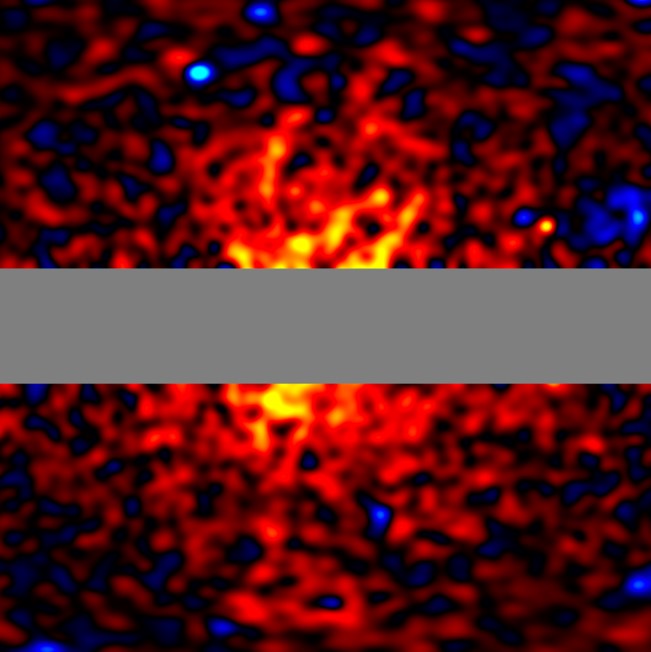
A century ago, astronomer Fritz Zwicky observed that galaxies were moving faster than their mass should allow, leading him to infer the presence of an invisible structure, dark matter. Since the particles that make up dark matter do not interact with electromagnetic force, they cannot be observed directly, as they do not absorb, reflect, or emit light. Now, NASA's Fermi space telescope has found specific gamma rays in the center of the Milky Way that are consistent with the decay of theoretical dark matter particles, although they could also come from other sources. “If this is correct, to my knowledge, it would be the first time that humanity has ‘seen’ dark matter,” said study author Tomonori Totani in a press release. The article is published in the Journal of Cosmology and Astroparticle Physics.
Miguel Ángel Sánchez - materia oscura Fermi EN
Miguel Ángel Sánchez Conde
Professor and researcher in the Department of Theoretical Physics at the Autonomous University of Madrid and at the Institute of Theoretical Physics (IFT UAM-CSIC), scientific coordinator of the entire NASA Fermi-LAT Collaboration between 2023-2025 and coordinator of the ‘Dark Matter and New Physics’ working groups of the Fermi-LAT gamma-ray collaborations (2014-16 and 2020-2022) and CTAO (2018-2020) collaborations
This work is part of the community's efforts to unravel the nature of dark matter—undoubtedly one of the greatest enigmas in science today—based on indirect signals in astrophysical data. In this case, the study focuses on WIMPs, by far the most studied candidate to date and the community's favourite. WIMPs are expected to annihilate in particularly dense areas of the universe, such as our own galaxy, giving rise to Standard Model particles that we can search for, such as gamma rays, the most energetic form of light in the universe and the subject of this particular work. After a couple of decades of uninterrupted searching with our gamma-ray telescopes, we still do not have a clear signal from these WIMPs, although there has been and continues to be some potential evidence over the years, which has not been fully confirmed despite our efforts.
Professor Totani's research uses gamma-ray data collected by NASA's Fermi satellite in the direction of intermediate regions of our galaxy, which are analysed and interpreted in a robust manner using completely standard tools in the field. The work is therefore of good quality and contains abundant checks that can be reproduced and interpreted in the context of searches for dark matter in the form of WIMPs. The study contains some interesting new developments compared to previous work (for example: the use of more years of data, an alternative treatment of some components of the diffuse galactic emission in the adjustments, a prior spatial smoothing of the data). If confirmed, the finding would have enormous repercussions both within and outside the community. It would undoubtedly be one of the great discoveries in the history of science.
Unfortunately, despite being a serious and highly noteworthy piece of work, its conclusions are currently subject to considerable uncertainty, making it impossible to claim that ‘this is the first time dark matter has been observed’. These uncertainties are the result of our still very limited knowledge about the exact production of gamma rays through conventional astrophysical phenomena in different areas of our galaxy. The study claims that these “conventional” processes are insufficient to explain the excess gamma radiation observed and that, therefore, this excess is due to the annihilation of WIMPs. However, there are very significant degenerations between the different components that we know contribute to diffuse galactic emission in this energy domain. This has led in the past to similar claims on several occasions that we had detected dark matter, when in all those cases a more detailed/complete study concluded that it was incorrectly modelled “conventional” astrophysics. The exception is the excess gamma-ray emission observed in the galactic centre, the origin of which is still unknown to us some fifteen years after its discovery (it is still a real possibility that it is due to dark matter). It is therefore not 100% certain that i) the aforementioned excess signal exists, given the current uncertainties in the modelling of diffuse emission, and that ii) this excess, if it exists, is due to dark matter and not to some other astrophysical component not yet considered.
Other equally relevant issues cast additional doubt on the interpretation of the observed excess in terms of dark matter. To explain this excess with WIMPs, as proposed in the paper, they would have to annihilate at a rate approximately ten times higher than expected (that is, if we wanted to explain all dark matter in the form of WIMPs). This high annihilation rate also seriously conflicts with the most robust estimates we currently have for WIMPs, which we have derived from observations of dwarf galaxies (the best objects for this type of search). The excess understood as WIMP annihilation would also require the distribution of dark matter in the galaxy to be particularly atypical and unexpected, as it would imply a sudden change in the areas closest to the galactic centre, so as not to conflict with our gamma observations in that area.
Jorge Sánchez - materia oscura Fermi EN
Jorge Sánchez Almeida
Research professor at the Canary Islands Institute of Astrophysics
Is the research of good quality?
“Yes. It is of good quality. It follows the standards and the conclusions are discussed in accordance with these.”
What are the implications of this finding?
"It depends on whether the explanation that gamma rays are produced by the decay of dark matter is confirmed in the future. If it is confirmed, then it would be very important because it would allow us to identify which physical models of dark matter are viable and which are not. But we are far from being able to make this confirmation.“
Is it correct to say, as in the press release, that this could be ”the first time that dark matter has been ‘seen’"?
"It is not correct, nor is it what the author of the scientific article says. He only says that an excess of gamma rays has been detected slightly outside the galactic center that could be compatible with the decay of dark matter particles.
Nor is it the ‘first time’ that an excess of gamma rays has been detected in the Milky Way. The author mentions previous studies in his article: ‘The so-called GC GeV excess with a sharp morphological peak at the GC, which may be a result of dark matter annihilation, has been found around a photon energy of a few GeV [7, 8, 35, 36]’ (GC stands for galactic center of the Milky Way).
Are there any important limitations to consider?
"Many, as is almost always the case in astrophysics. The work interprets a signal that could be caused by conventional astrophysical sources and by the decay of dark matter. Both must be modeled to conclude that the observed signal is incompatible with known sources and compatible with what would be expected from dark matter. Both models are highly uncertain. There is uncertainty in the contribution of astrophysical sources (e.g., Fermi Bubbles) and uncertainty in the expected signal from dark matter (e.g., the distribution and density of the Milky Way's dark matter halo are unknown).
Juan Abel Barrio - materia oscura Fermi EN
Juan Abel Barrio
Professor of Atomic, Molecular, and Nuclear Physics in the Department of Structure of Matter, Thermal Physics, and Electronics at the Complutense University of Madrid (UCM) and researcher in Gamma Ray Astrophysics at the Institute of Particle Physics and Cosmos (IPARCOS) at UCM
"The search for dark matter, whose existence in particle form is only a hypothesis without experimental evidence, is one of the most difficult searches that physics has faced in the last 100 years; it is one of the ‘holy grails’ of physics that, to date, has proved fruitless. NASA's Fermi gamma-ray satellite has been operating for more than 15 years, one of its objectives being to identify gamma rays hypothetically produced by the annihilation of dark matter particles. The Fermi international collaboration, made up of approximately 150 scientists from around the world (not just NASA), is one of the groups that knows the experiment best and has spent the most time studying the region of the galaxy referred to in the article. It is a particularly complicated region due to the number of ‘standard’ sources and processes that can give rise to gamma rays that could mimic those coming from dark matter.
This collaboration has been searching for evidence of dark matter in different regions of the sky, including our galaxy, for all this time, carrying out very careful analyses, verified by dozens of experts. And it has found no statistically significant evidence of gamma rays coming from dark matter. If it had, the announcement would have come officially from NASA, it would have been sent to Nature, and it would have meant a Nobel Prize the following year.
That said, the Fermi international collaboration makes the information on all the gamma rays it has observed publicly available so that researchers outside the collaboration, such as the author of this paper, can analyze them. On some occasions, one of these researchers has found a ‘minor’ detection (unrelated to dark matter) that had been overlooked by the Fermi collaboration researchers, but given that this is such a coveted search, I would find it very strange if this detection of gamma rays produced by dark matter particles had been overlooked.“
Is the research of good quality?
”Not really."
Does it fit with the existing evidence?
“No. The author himself says that the average he obtains is outside the exclusion limits obtained by the Fermi collaboration.”
What are the implications of this finding?
“If it were officially confirmed by the Fermi collaboration, which I highly doubt, and which is the only one I would personally trust, it would effectively be finding one of the holy grails of physics, opening the door to physics beyond the Standard Model of particle physics, etc.”
Is it correct to say, as in the press release, that this could be the “first time that dark matter has been ‘seen’”?
“No, in the sense that it has not been seen, but rather proposed as evidence, which I would consider unreliable. And there have already been more indications of dark matter in the last 20 years, which have ultimately been ruled out.”
Tomonori Totania.
- Research article
- Peer reviewed