Extreme droughts slow the carbon storage capacity of scrublands and grasslands
Some ecosystems are able to adapt to moderate droughts, even if they last for several years. However, in scrublands and grasslands, when the phenomenon is extreme and prolonged, their capacity to store carbon plummets. This is the main conclusion of an international study that has assessed the effects of the duration and severity of droughts on the productivity of 74 grassland and pasture ecosystems on six continents. According to the authors, the most vulnerable areas are arid and semi-arid regions, such as those in the Mediterranean region and the southwestern United States. The study, published in Science, involves CREAF, CSIC and IICG-URJC, among other centres.
Gustavo Saiz - sequía extrema EN
Gustavo Saiz
Forestry engineer and senior scientist at the National Institute for Agricultural and Food Research and Technology (INIA-CSIC)
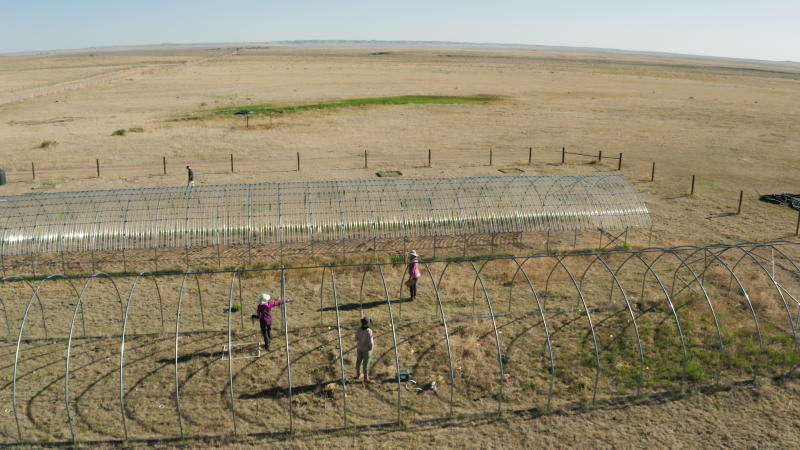
This study uses a large number of international drought simulation experiments involving rain exclusion covers in grasslands and scrub ecosystems. The aim of this work is to discern the impact that both the severity and duration of droughts have on the functioning of these ecosystems, particularly on their plant productivity. The study shows that, in general, there is a decrease in productivity during the first year of drought. However, it suggests that these ecosystems may acclimatise (i.e. maintain productivity similar to that observed during the first year of drought) if there are no extreme droughts in subsequent years. Conversely, it is observed that an increase in drought severity to historically extreme levels could result in a pattern of cumulative productivity loss over time.
The work is rigorous and incorporates a comprehensive database with robust analyses and interpretations. It is regrettable that experiments in critical regions (e.g., those with highly degraded soils that are widely distributed, such as the Sahel or the vast regions of Central Asia) are not included. On the other hand, as the authors explain, another clear limitation of this work lies in the lack of temperature manipulation in the experiments. This aspect is relevant since drought is associated with both higher temperatures and higher vapour pressure deficits, which have the potential to reduce photosynthesis and, therefore, productivity. Thus, it is possible that the study has minimised the impact of drought on the variable studied.
Nevertheless, it is (correctly) concluded that the productivity losses observed in the ecosystems studied could intensify due to the more than likely increase in extreme drought events projected in the current climate framework. Finally, it is very likely that the impact of extreme droughts will also result in a significant increase in plant mortality and a substantial degradation of ecosystem services.
Francisco Lloret - sequías extremas EN
Francisco Lloret
Professor of Ecology at the Autonomous University of Barcelona and CREAF researcher
This is a solid article, whose main values are:
- It is a global study carried out in scrublands and grasslands around the world, harmonising numerous small-scale experimental field studies on climate manipulation (plots of a few square metres). It is worth noting the difficulty of carrying out these studies, but they benefit from the networking of numerous scientific groups.
- It highlights the distinction between two components of droughts: their intensity and their duration. It should be emphasised that climate change scenarios point to an increase in the duration and intensity of droughts in many parts of the world. The study is therefore highly relevant and timely.
- The results show a certain capacity for adaptation to droughts on the part of the vegetation studied. However, there is a greater impact when the duration and intensity of the drought are combined. In other words, as the drought continues, the effect of the intensity of the drought is greater.
- These results provide evidence for relevant ecological hypotheses, such as the disproportionate increase in ecological impacts when different stress elements are combined.
As for limitations:
- This is a global study that shows general trends, but that does not mean that each specific situation will reproduce the results obtained. There is significant variability that deserves to be monitored at the local level.
- The duration of the experiments is limited (three to four years) and long-term experimental and monitoring studies harmonised across many sites are needed.
- The study assesses a single variable (net primary production or productivity) that describes the functioning of the system, as it integrates multiple ecological processes, but, for example, the impacts on nutrient balances or biodiversity are not assessed.
- Only certain types of terrestrial ecosystems are assessed: scrubland and grassland. Although these are important, it remains to be seen whether the results are consistent in other ecosystems, such as forests. In forests, climate manipulation experiments are more difficult and costly, but they are also carried out.
Conflicto de interés: “Conozco personalmente a algunos de los autores del trabajo, pero no he participado en nada en los estudios que se reportan ni en la evaluación del estudio”.
Timothy Ohlert et al.
- Research article
- Peer reviewed