The presence of a solid inner core has been detected on Mars
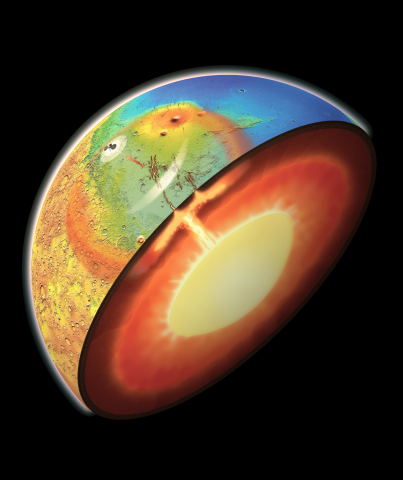
Previous studies had confirmed the presence of liquid in Mars' core. However, there was conflicting information about the possible existence of a solid component. Now, data from NASA's InSight mission show that there is indeed a solid component in the planet's core, whose radius is estimated at about 600 kilometers. The data, published in the journal Nature, may increase our understanding of the formation and evolution of Mars, as well as its potential habitability.
Susana - Núcleo Marte (EN)
Susana del Carmen Fernández Menéndez
Vice-President of the Planetary Geology Commission of the Geological Society of Spain, Secretary of the Iberian Hub Europlanet, Coordinator of the MapPlaneST research group, and Lecturer in the Department of Geology at the University of Oviedo
I believe the article is of high scientific quality. It is based on seismic data from the InSight mission, which is a lander, a multi-probe that lands on the body being explored and does not have wheels.
InSight (Interior Exploration using Seismic Investigations, Geodesy and Heat Transport) was a NASA mission that landed on Mars in 2018 and was active until the end of 2022. Its objective was to study the planet's interior, measuring seismic activity, internal heat, and the properties of the core and mantle. It is equipped with the SEIS seismometer, which detected hundreds of earthquakes or "marsquakes." Thanks to these seismic waves, it was possible to understand the internal structure of Mars, similar to how earthquakes are studied on Earth to understand the crust, mantle, and core.
The authors of the article present a very robust and apparently well-founded analysis. The discovery of a solid inner core on Mars is a result of enormous relevance for understanding the evolution of Mars and other rocky planets and moons. It is comparable in importance to the confirmation of the previously known liquid core. The authors present clear evidence with seismic phases and offer consistent estimates of the inner core's size and physical properties.
News compared to previously published data
Until now, it was known that Mars had a liquid core rich in light elements, but the existence of a solid core was not yet confirmed. In fact, previous work had concluded quite the opposite, that the core was completely liquid. This article provides the first direct and convincing identification of a solid inner core on Mars, which represents an important paradigm shift for understanding the thermal evolution of Mars. The fact that Mars continues to exhibit internal geological processes is very relevant for understanding whether it could still be a habitable planet.
The discovery has other implications:
1. It provides new clues to explain why Mars lost its global magnetic field.
2. It helps to understand the processes of iron crystallization and core formation on rocky planets and moons in general.
3. Implications of the discovery for the current habitability of Mars:
In principle, the fact that Mars has a solid inner core surrounded by a liquid outer core is directly related to the planet's magnetic evolution, and this is very important because it has implications for its past habitability.
For example, on Earth, the growth of the solid core releases heat and light elements into the liquid core, which maintains the dynamo that generates the magnetic field. This field protects the atmosphere and surface from solar and cosmic radiation, which is key for life.
The discovery of a solid core on Mars indicates that in the past it may have also sustained an active dynamo, consistent with the existence of a strong magnetic field 4 billion years ago. This magnetic field would have protected the atmosphere and allowed for more habitable conditions on the surface. However, the study suggests that crystallization is too slow today to sustain a global magnetic field. This would explain why Mars has lost its magnetic shield, facilitating the loss of its atmosphere, eroded by the solar wind, and drastically reducing its current potential habitability.
This discovery does not mean that Mars is now habitable, but it confirms that in the past it had an active core and a global magnetic field, which would have favored the existence of stable liquid water on the surface and more benign conditions for life.
[Regarding possible limitations] The study is solid, but has obvious limitations, as it is based on a very limited set of seismic records from the InSight mission. Furthermore, although it confirms the existence of a solid inner core, it still does not allow us to precisely detail its exact composition or its role in the current internal dynamics of the planet.
Frías - Núcleo Marte sólido (EN)
Jesús Martínez Frías
Planetary geologist and astrobiologist at the IGEO (CSIC-UCM). Academician of the Royal Academies of Sciences and Doctors of Spain. President of the Planetary Geology Commission of the Geological Society of Spain and of the Spanish Network of Planetology and Astrobiology.
This is a very interesting and high-quality study that underscores the importance of geophysics and in situ analysis on Mars, beyond existing theoretical models of the Red Planet's core.
The study fits with existing evidence. Previous observations on Mars had confirmed that the core was partially liquid, but thanks to the InSight mission, we know that the inner core, specifically, is solid.
I find it very interesting that the solidity pattern of the inner core follows the same patterns as on the Moon and Earth, suggesting analogies in the evolution of their differentiation processes after accretion.
The geophysical implications relate to the geodynamics of Mars itself, its loss of its magnetic field, models of planetology compared to other planetary bodies, such as Mercury or Ganymede, and also to the existence, even today, of a possible "Martian geological vitality" in terms of the interaction between the outer and inner core, which could even be important for astrobiological purposes.
The research is very well developed, but obviously more geophysical studies are needed, with more missions similar to InSight.
Furthermore, we only have a current "snapshot" of the interior of Mars, and it would be interesting to know, through paleomagnetism studies of rocks and minerals, how it has evolved over the billions of years since its origin and whether this may have also influenced possible heterogeneities in the mantle.
Molina - Núcleo Marte sólido (EN)
Antonio Molina
Planetary geologist specialising in Mars in the Department of Planetology and Habitability at the Centre for Astrobiology (CAB)
I find the work very interesting and represents an important step forward in better characterizing the planet and improving our understanding of the internal configuration and evolution of Mars and other planets and moons about which we know relatively little. Its publication in a journal as renowned as Nature suggests that it has undergone an exhaustive peer-review process and is based on data from NASA's InSight mission, which provides reliability.
Because knowledge of the characteristics of the interior of planetary bodies comes from numerical modeling using indirect sources, such as how a body moves in space (orbital dynamics) or how vibrations propagate from one side of the planet to the other (seismic waves), much remains to be determined, even for our own planet. The discovery of Earth's solid inner core took place less than 100 years ago, and very recently it has been suggested that its structure could be even more complex (e.g., this article from last year in this same journal). Therefore, advances in various fields still allow for paradigm shifts in how we understand the elusive interior of planetary bodies.
Until now, the most widely accepted model assumed that Mars' core must be completely liquid. Mars has magnetic anomalies, not a global magnetic field like Earth's, but its crust is highly magnetized. This would mean it must have had a global magnetic field produced by a dynamo that currently does not exist. This dynamo would consist of electrically conductive material (rich in iron, for example) that, when liquid due to the high temperatures and pressures of the planet's interior, would move and generate magnetic forces. These are not only responsible for compasses pointing north and the northern lights, but also have a major impact on the habitability of Earth by protecting us from the solar wind. Based on the data previously available on Mars, the hypothesis that best fit these changes in magnetism (an ancient but currently absent global field) was that the core was completely liquid.
This work presents that, according to the analysis of seismic data from the recent InSight mission, the "inner core" of Mars could be solidified, although it maintains that the outer part of this core should still remain in a liquid state (as is the case on Earth). Until now, the only seismological data on Mars, which are one of the main sources for understanding a planet's interior, came from the Viking missions launched by NASA in the 1970s. But due to their characteristics and configuration (they were not in direct contact with the ground), the results were very limited. InSight's seismometer, SEIS, was the first to obtain direct data from the surface with high sensitivity, and the detailed analysis of these signals has allowed these researchers to make this new interpretation that changes the current paradigm.
One implication would be that Mars is more like Earth than previously thought. Not only does it have a core that differentiates between these two states, but the authors propose that the solid inner core would reach 0.18 of its radius, while on Earth it is 0.19. One possible interpretation is that Mars is older than we thought (it has already begun the crystallization process of its interior and will be able to retain its internal heat for less time), but at the same time, the crystallization process may imply that Mars is "more alive," maintaining more efficient convection and therefore greater geological activity. In any case, it is a further step in understanding what planetary bodies are like and how they evolve.
[Regarding possible limitations] As the study itself states, the seismic analyses come from a single seismometer (InSight's SEIS), which implies some uncertainty. Future, more widely distributed seismological measurements could definitively confirm this interpretation, and in the absence of new data, studying the impact of this new configuration on the most advanced numerical models will allow us to better understand the planet and its evolution.
Bi et al.
- Research article
- Peer reviewed