The current humanitarian system was created after the Second World War and underwent substantial reform at the end of the 20th century. This system is a combination of legal instruments such as laws and treaties and a network of governmental and non-governmental institutions that contribute to its implementation. At the global level, humanitarian aid in war contexts is managed through an international system coordinated by the United Nations (UN). This management must be governed by four essential humanitarian principles: humanity, neutrality, impartiality and operational independence. These principles are recognised by the UN General Assembly and are required by International Humanitarian Law (IHL).
The management of humanitarian aid in the Gaza Strip by the Gaza Humanitarian Foundation (GHF), following a plan established by the Israeli government and supported by the US government, has been strongly questioned. Despite the obligations established by IHL and the global consensus on the principles governing humanitarian action, the policies implemented by Israel have systematically violated these pillars.
An article published in The Lancet last May already warned that almost half a million people in Gaza were at risk of starvation due to systematic restrictions on the entry of aid.
Aid has been used as a tool for military pressure and subject to political and logistical conditions that have prevented its effective and safe distribution. This situation has culminated in the food distribution system organised by the Israeli army, which has imposed delivery routes under military supervision, during which nearly a thousand people have been killed. An article published in The Lancet last May already warned that nearly half a million people in Gaza were at risk of starvation due to systematic restrictions on the entry of aid, facing a health emergency that had already reached catastrophic proportions four months ago.
How food insecurity is assessed
The Integrated Food Security Phase Classification (IPC) serves as a system for classifying the different stages of current food security situations, based on their impact on both people's lives and their livelihoods. It is a global and innovative initiative, based on collaboration between multiple actors, whose objective is to improve the analysis of food security and nutrition in order to guide decision-making. Globally, it brings together more than twenty intergovernmental organisations and institutions, including the Food and Agriculture Organisation of the United Nations (FAO), the World Food Programme (WFP), the World Health Organisation (WHO), UNICEF, the World Bank and various NGOs and regional bodies.
The results obtained enable governments, United Nations agencies and humanitarian organisations to work together to assess the severity and magnitude of food insecurity and acute malnutrition, following recognised international standards. To this end, it distinguishes five phases of food security: 1 (full food security), 2 (mild or moderate food insecurity), 3 (acute food and livelihood crisis), 4 (humanitarian emergency) and, at the most severe level, 5 (famine or humanitarian catastrophe). In addition to classification into one of these five phases, the CIF considers the risk of the situation deteriorating, which is referred to as the ‘risk of phase escalation’ and is classified into three levels: alert, moderate risk and high risk.
According to the Integrated Phase-based Food Security Classification, the situation of the population in the Gaza Strip is at phase 5 (famine) for half a million people, representing 22% of the population of Gaza.
The IPC compiles and combines multiple sources of information (agricultural production, prices, nutrition, conflicts, etc.) to provide an analysis of the food security situation. Its results are expressed in maps and tables that show the severity and magnitude of food insecurity. The IPC process is part of a continuous cycle of analysis and response. This analysis covers six key aspects: the severity of the impact on lives and livelihoods, the geographical extent of the crisis, the number of people affected, the immediate and structural causes, and the identification of basic needs and livelihood support.
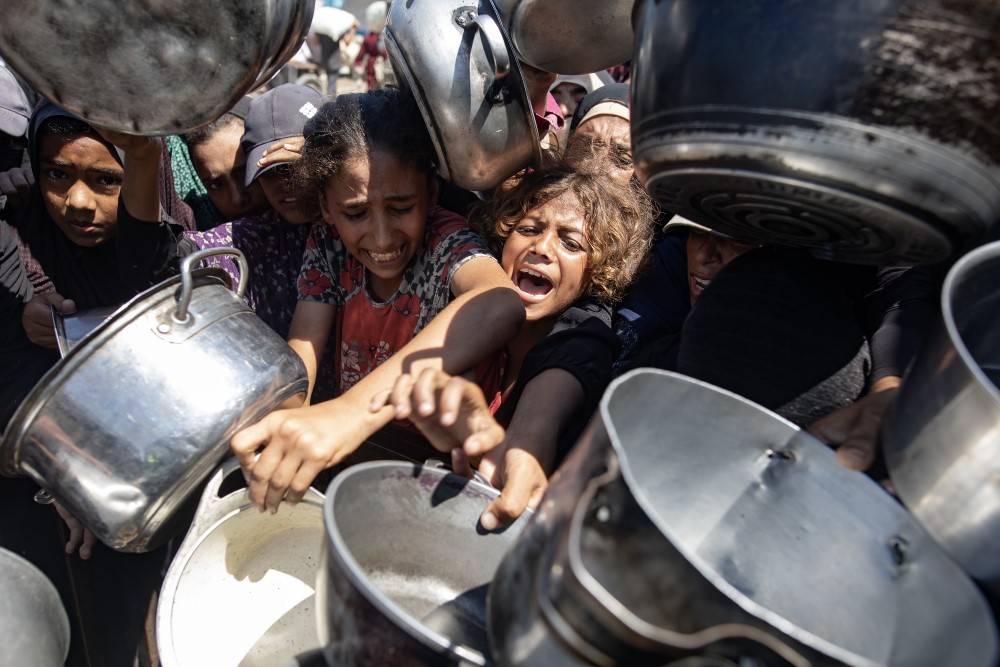
According to the IPC, the current situation of the population in the Gaza Strip (projection from May to September) is phase 5 (famine) for half a million people, representing 22% of the population of Gaza. This famine is defined as an extreme situation of food insecurity in which there is insufficient access to food to survive, leading to high rates of malnutrition, disease and mortality. In addition, more than one million people are at level 4 (humanitarian emergency) and it is considered that, in the current context, this situation will worsen. Finally, it should be noted that the entire population of Gaza is in a situation of food or subsistence crisis or worse (phase 3 or higher).
The UN's declaration of famine. What now?
On 22 August, the UN officially declared famine in Gaza, the first in the Middle East, caused by the deliberate collapse of essential systems and the blockade of basic supplies by the Israeli government. António Guterres, UN Secretary-General, described it as a man-made disaster and a moral failure of humanity. The state of Israel, the UN declared, has a legal obligation as an occupying power to guarantee basic humanitarian supplies, such as food and medicine. Using hunger as a weapon constitutes a war crime. Tom Fletcher (Humanitarian Affairs Coordinator) denounced that food is accumulating at the borders while the population goes hungry, due to systematic obstruction by the Israeli government.
Food aid alone is not enough: integrated multisectoral interventions (food, nutrition, health, water and livelihoods) are needed, along with the restoration of commercial supply chains, services, markets and large-scale local production.
According to CIF recommendations, preventing famine requires an immediate and unconditional ceasefire, as well as safe and sustained access to humanitarian assistance in order to deliver essential aid (food, healthcare, water, sanitation, fuel and other basic services). It is essential to protect the civilian population, humanitarian personnel and critical infrastructure to ensure that assistance reaches its destination. Food aid alone is not enough: integrated multisectoral interventions (food, nutrition, health, water and livelihoods) are needed, along with the restoration of commercial supply chains, services, markets and large-scale local production.
The UN's declaration of famine in Gaza has several implications. Firstly, it officially recognises the situation of extreme deprivation in Gaza and points to the legal responsibility of the Israeli government. Secondly, it draws attention to the crisis and thus intensifies international political pressure to intervene diplomatically and demand a ceasefire and access for humanitarian aid. Finally, the declaration serves as a technical and legal basis for monitoring impacts, holding actors accountable and recording human rights violations.
In this regard, the Spanish Society of Epidemiology (SEE) aligns itself with the objectives of international agencies and NGOs in demanding an immediate ceasefire and safe supplies with coordinated strategies to ensure security, equity and the restoration of infrastructure and access in Gaza as soon as possible.