A study warns of the impact that satellite megaconstellations will have on images from space telescopes such as Hubble
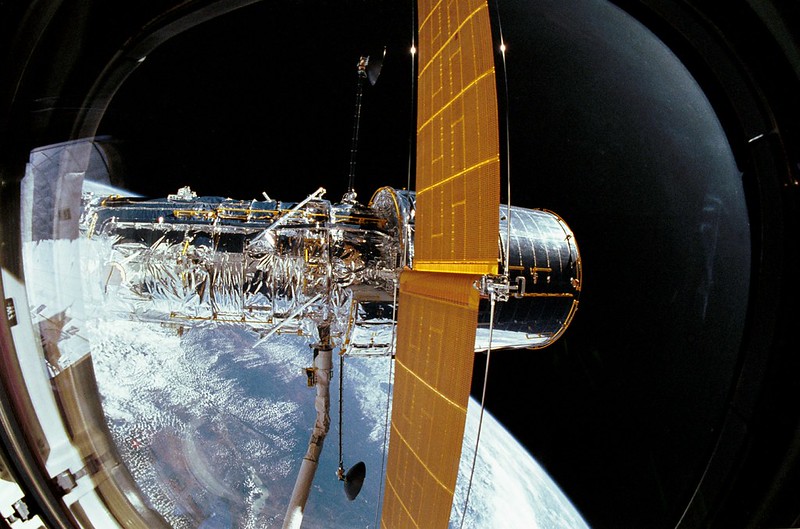
The rapid growth of satellite constellations threatens the operation of space telescopes, according to a study published in Nature. If the planned launches are completed, the Hubble Space Telescope could see more than a third of its images affected by light pollution from these satellites, as they share the same orbital space, while other telescopes would have more than 96% of their images damaged, the authors estimate.
251203 satélites jorge EN
Jorge Hernández Bernal
Researcher in the Laboratoire de Météorologie Dynamique, Sorbonne Université, CNRS (France)
In recent years, mega-constellations of satellites have been a concern for the scientific community, among other reasons because satellites, when crossing the field of view of telescopes, can spoil astronomical observations. Those of us who often gaze at the night sky have observed with concern in recent years a scandalous increase in the number of satellites that can be seen constantly with the naked eye. Some techno-optimists have proposed, not without a certain cynicism, that the solution will be to move astronomical observations completely into space, generalising space observatories such as the famous Hubble or the more recently launched JWST.
This study systematically quantifies for the first time the effect of satellite megaconstellations on space observatories (an effect that was already known) and shows that they will be a very serious problem for some of the major observatories currently being planned.
Although the study proposes some solutions to mitigate these effects, such as raising the orbit of astronomical observatories to separate them from megaconstellations, the authors are aware that such solutions are merely patches that do not address the whole problem or its root causes.
In addition to threatening astronomical observations, megaconstellations degrade the cultural heritage that is the night sky; they endanger the peaceful and common use of space by increasing the risk of Kessler syndrome; they involve a high number of rocket launches and space debris disintegrations, with their consequent impact on the ozone layer and climate change; etc. The problem with satellite megaconstellations is, like other problems of our civilisation (the climate, eco-social and resource crises, the drift towards war, etc.), simply a symptom of a socio-economic system out of control which, with its irrational desire for growth towards nowhere, is dragging us towards collapse.
The excessive power of megacorporations and the unwillingness of the imperialist powers of the global North to negotiate are blocking the development of international agreements and regulations that would enable the rational and fair use of space for the whole of humanity. As a result, the number of satellites planned for deployment is simply unsustainable, and there is no coordination or planning to meet the needs. The deployment of mega-constellations is responding to particular interests and competition between mega-corporations and states.
The solution lies in a real democratisation of space. This implies, among other things, that decisions are multilateral, transparent and open to international civil society, rather than being taken behind the backs of citizens and at the mercy of particular states and companies. We should ask ourselves: What services can mega-constellations offer us? Which of these services are truly desirable and useful for the general well-being in the context of the climate and ecological crisis? Do we want to have mega-constellations of satellites? And if so, how can we implement these services fairly and efficiently at the global level?
251203 satélites alejandro EN
Alejandro Sánchez de Miguel
EMERGIA post-doctoral research in the Sky Quality Office
Is the study based on solid data and methods?
"Yes, it's based on publicly available data."
How does it fit in with previous work? What new insights does it provide?
"It expands on previous studies, which until now had focused mainly on ground-based astronomy. The main new insight is to show how this will not only affect ground-based astronomy, but also space astronomy."
Are there any important limitations to consider?
"This study is even optimistic, as there are satellites that have not been considered, such as those currently being evaluated by Reflective Orbital and other projects in China and Russia. Some are planned to launch as early as next year. It is difficult to keep track of all the business initiatives that are emerging, and some of this information was not available when the article was submitted or does not yet exist."
How relevant is this study in practice?
"The lack of media coverage in an area that represents a cultural and strategic loss of this magnitude is striking, both for ground-based and space-based astronomy and global cultural traditions, as well as for its ecological impact, as it is an uncontrolled geoengineering experiment. The impact on astronomy is not even the tip of the iceberg of this problem. There are other much greater risks, for example, to air traffic, climate change or cultural genocide. Cultural genocide occurs when you prevent a particular culture from surviving. In particular, there are several cultures – some recognised as intangible heritage of humanity – that need the vision of the stars for their transmission. A paradigmatic example is the Aboriginal cultures of Australia, but they are not the only ones.
This study shows how we are not only going blind in ground-based telescopes, but also in space telescopes, which will result in additional costs to raise future telescopes above this layer of space debris, not to mention the risk of being hit by space debris.
What we must do is start applying existing space legislation to try to mitigate the impact of these mega-constellations as soon as possible and raise awareness of their effects.
“Mi declaración de conflictos de interés completa está aquí.”
251203 satélites olga EN
Olga Zamora
Support astronomer at the Canary Islands Institute of Astrophysics
The study addresses the major problem of light pollution caused by satellite trails in space telescopes, both those already in operation (Hubble, SPHEREx) and those that will be in the near future (ARRAKIHS, Xuntian).
It is remarkable how wrong past public statements were, such as when Elon Musk proposed -when the Starlink constellation started to be launched- that astronomers place telescopes in space to avoid pollution.
The impact of satellite constellations in low Earth orbit (LEO) has been simulated, introducing an increasing number of satellites representing conditions in LEO, from ~2000 (approximate number of satellites in 2019) to the 560,000 announced by the telecommunications industry for the year 2037 (e.g., Starlink, OneWeb, Guowang, Astra, and others). The data and methodology are robust and well-tested, using public constellation profiles and Python modules such as Skyfield for the calculations.
There has been no such detailed study of the impacts on space telescopes. The current pollution is well known and evident in many images from space telescopes in operation.
The novelty of this work is that it provides a global vision of the future if the plans to launch the constellations are carried out, which puts space telescopes of maximum scientific interest in jeopardy. The results of the simulations are devastating and very alarming: 39% of the images from the Hubble Space Telescope will have at least one satellite trail, with an average of two satellites per image. In the case of SPHEREx, ARRAKIHS, and Xuntian, 96% of the images will show satellite trails, with an average of six, 70, and 90 satellites per image.
As for the brightness of the satellite trails, the spectral energy distribution has been realistically simulated using the reflected emission from the Sun, the Moon, and the Earth's albedo, in addition to the infrared emission from satellites.
The results show that a significant proportion of satellites are detectable by telescopes even without being directly illuminated by the Sun and are exceptionally bright in the infrared due to the thermal emission of their electronic components.
Given that the launch of satellite constellations is following a virtually exponential progression, the study indicates that we must stop this situation before it is too late. The science of the future is at stake.
Conflicts of interest: "Borlaff [the first author of the study] worked at the same institution from 2014 to 2018, although not in the same research group".
Alejandro S. Borlaff et al.
- Research article
- Peer reviewed
- Modelling