The Iberian Peninsula and the Canary Islands register the arrival of African air masses with dust concentrations
According to the Ministry for Ecological Transition and Demographic Challenge, masses of African air with varying concentrations of surface dust are expected to reach the Canary Islands and the Iberian Peninsula on Wednesday. Health authorities in different provinces have recommended avoiding outdoor physical exercise or activities that require effort, especially for vulnerable groups such as children, pregnant women, the elderly and the sick.
260224_Julio Díaz_polvo
Julio Díaz
Research professor and co-director of the Reference Unit on Climate Change, Health and the Urban Environment at the Carlos III Health Institute
The problem will not only be the increase in PM (particulate matter) concentration, but also the increase in NO2 (nitrogen dioxide) concentration.
PM comes from both natural and anthropogenic sources, such as vehicle emissions in Madrid. If increases in natural PM and NO2 are expected, the main source of which in cities is traffic, perhaps the recommendations should go beyond limiting outdoor activities and consider traffic restrictions if the health of citizens is to be protected.
Ernest Ewerner - polvo sahariano EN
Ernest Ewerner
Aemet meteorologist
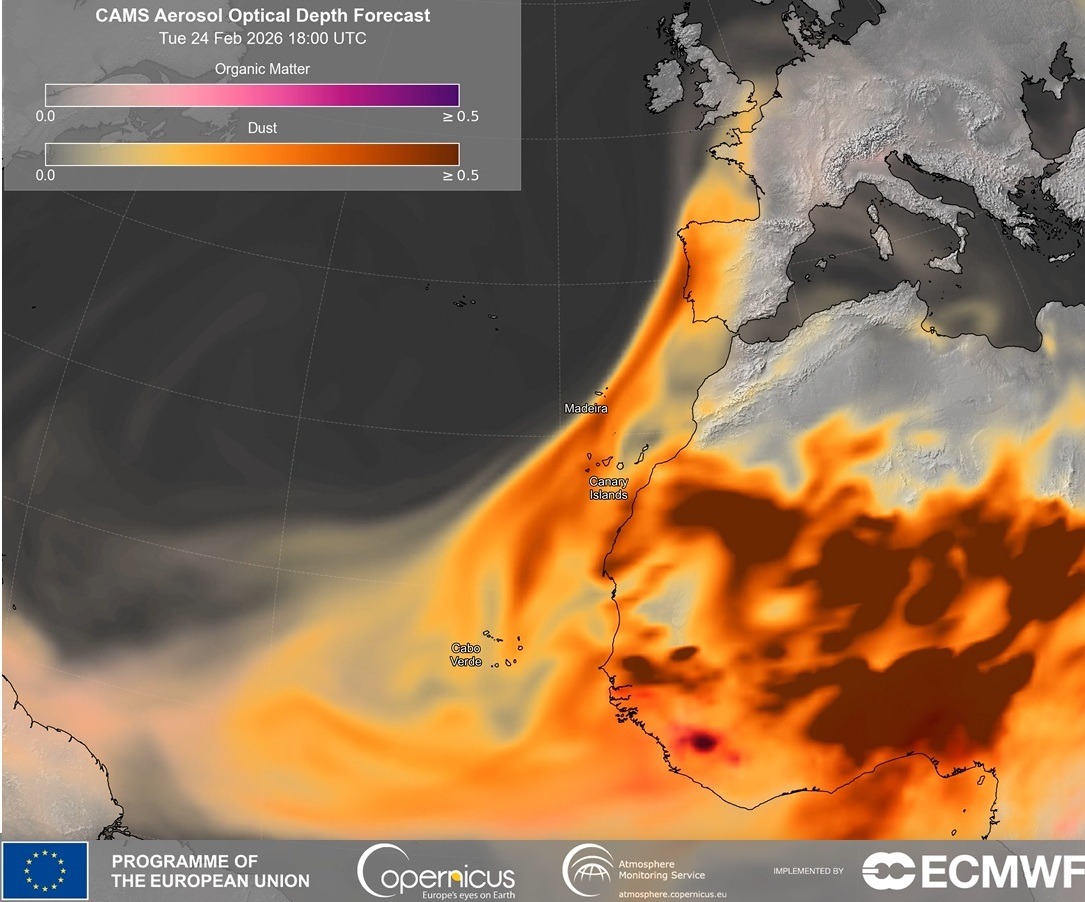
The Atlantic frontal system approaching the Iberian Peninsula is collecting and transporting Saharan mineral dust that has been emitted from Africa in recent days, accumulating off the African coast and also affecting the Canary Islands. This type of situation usually occurs in spring and tends to produce moderate intrusions of Saharan dust.
These situations are different from those caused by a cold drop located in the south-west of the peninsula, which is capable of generating intense winds in the desert source areas of North Africa, emitting large quantities of dust and transporting it to the Iberian Peninsula, resulting in strong or very strong intrusions with high concentrations of particles.
In general, concentrations are expected to exceed 50 micrograms/m³ on average per day, especially in the western half and centre of the Iberian Peninsula. Muddy rainfall is also possible during the episode. These concentrations are expected to remain at this level over the next few days, gradually decreasing towards the weekend. Another dust intrusion is also expected to affect the Canary Islands from Thursday afternoon onwards.
This value (50 micrograms/m³) corresponds to the daily limit for average PM10 (particulate matter with a diameter of 10 micrometres or less) in force in the European Union, so it is recommended to limit outdoor activities, particularly for the most sensitive sectors of the population, such as children or people with respiratory diseases. It should be noted that the mineral dust transported is added to the total PM10 recorded at air quality stations.