Ramón López de Mántaras

Ramón López de Mántaras

Ramón López de Mántaras
Position

Computer scientist and physicist, emeritus research professor at the CSIC, founder of the Institute for Research in Artificial Intelligence (IIIA-CSIC), honorary professor at Western Sydney University and a pioneer of AI research in Spain

OpenAI’s new Astra model

The artificial intelligence (AI) company OpenAI has unveiled GPT-6 Astra, “the world’s smartest and best-aligned model”, according to the company. The new model will use a technique known as ‘opaque recurrence’, which allows it to operate outside the sequential thinking of most reasoning models and which is causing concern amongst AI safety experts due to the possibility that the model’s thought process may be more difficult to monitor.


0

An AI system could win a medal at the International Mathematical Olympiad, according to a study

A team at Google DeepMind has developed AlphaProof, an artificial intelligence system that learns to find formal proofs by training on millions of self-formulated problems. According to the authors, the system “substantially improves upon previous-generation results on historical problems from mathematical competitions.” Specifically, in the 2024 International Mathematical Olympiad (IMO) for secondary school students, “this performance, achieved after several days of computation, resulted in a score equivalent to that of a silver medalist, marking the first time an AI system has achieved medal-level performance.” The results are published in the journal Nature.

0

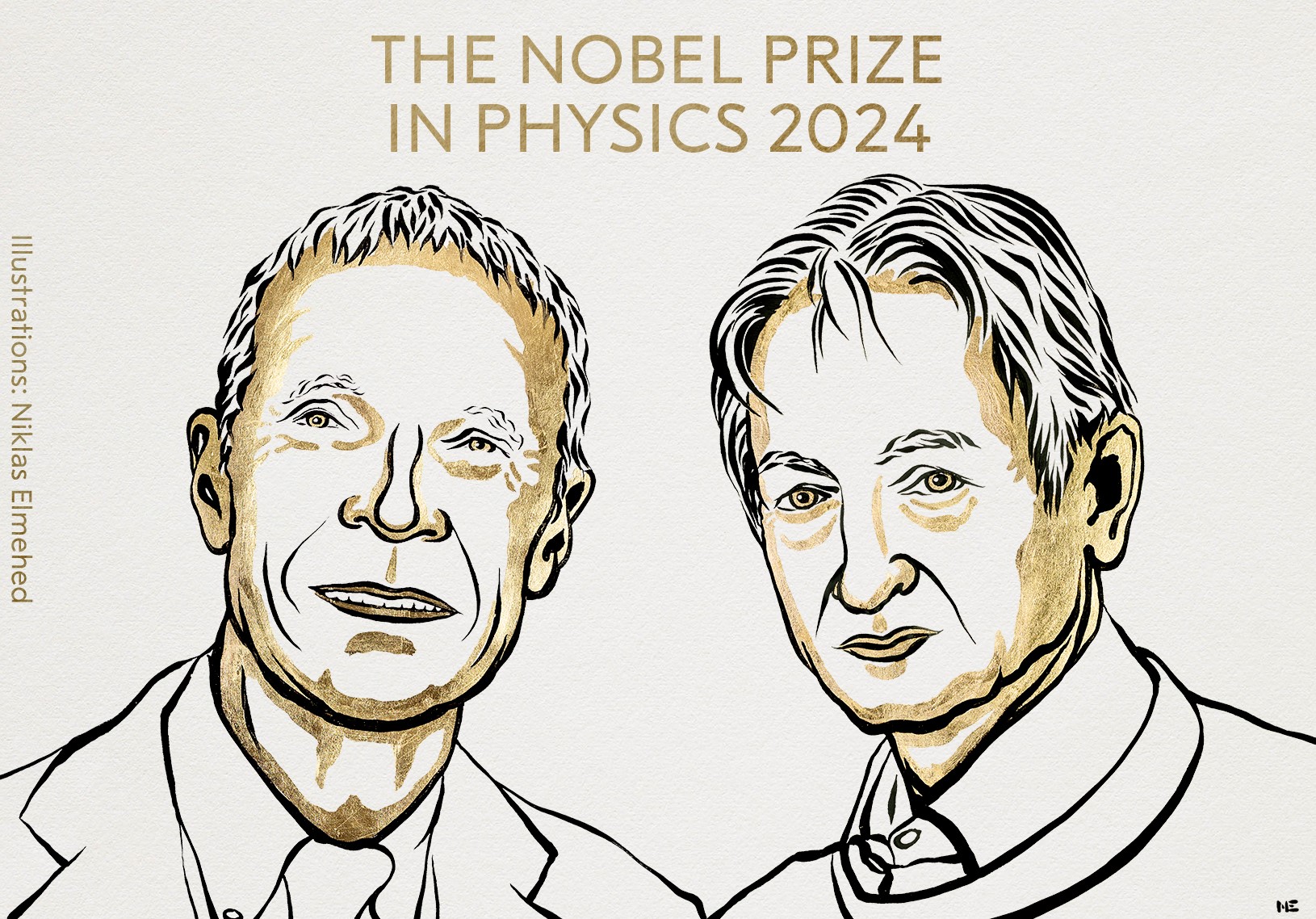
Nobel Prize in Physics for Hinton and Hopfield for discovering the basis of machine learning with artificial neural networks

The Royal Swedish Academy of Sciences has awarded the Nobel Prize in Physics 2024 to researchers John J. Hopfield and Geoffrey E. Hinton for discovering the foundations that enable machine learning with artificial neural networks. Hinton for discovering the foundational basis that enables machine learning with artificial neural networks. This technology, inspired by the structure of the brain, is behind what we now call ‘artificial intelligence’. 

0