Electrodes capable of evoking vision and adapting in real time are implanted in the brains of two blind people
A team from the Miguel Hernández University of Elche and the Alicante Hospital has implanted a microelectrode array in the brains of two blind people. This array is capable of sending electrical stimuli that evoke visual perceptions, something that has been done before, and also of "reading" neuronal responses and adapting to them in real time. The system has allowed them to recognize various complex patterns, movements, shapes, and even some letters. According to the researchers, this new technology "can help make the difference between perceiving a flash and seeing the world." The results are published in the journal Science Advances.
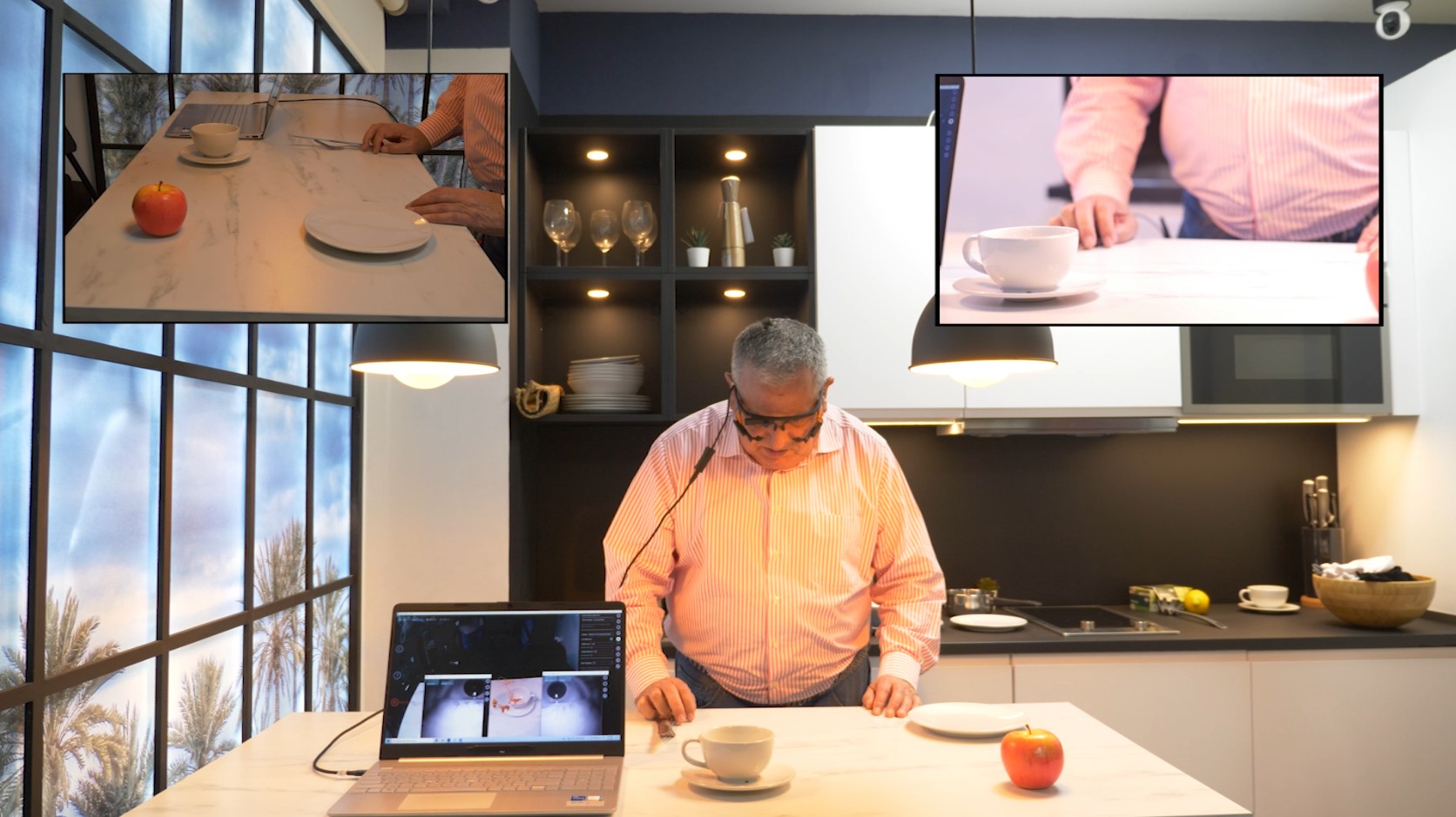
Study participant performing tasks similar to those in daily life. Author: Institute of Bioengineering, Miguel Hernández University.
Lozano - Visión Electrodos EN)
Antonio Manuel Lozano Ortega
Researcher in the Biomedical Neuroengineering group at the Miguel Hernández University (UMH) of Elche
This is a high-impact article. Science Advances is able to obtain peer review from scientists/researchers with experience in various fields, which ensures that published articles have a very high overall quality and great clarity in their methodologies and results.
For decades, researchers in the field of cortical visual prostheses have accumulated evidence, in both humans and primates, of how cortical electrical stimulation can generate artificial visual perceptions (which we call phosphenes).
In previous work, we demonstrated simple visual perceptions generated with this same technology in humans, thanks to our first blind participant in the CORTIVIS study.
In this new work, Fabrizio Grani and the rest of the team, thanks to two new participants, conducted a comprehensive study of how this type of visual neural implant generates artificial perceptions (phosphenes), and how stimulation parameters modulate (change) these perceptions. For example, they examined how varying the current intensity, the frequency of the biphasic pulses, and the duration of stimulation modifies the brightness perceived by the participants.
Furthermore, and critically, the research team analyzed the responses of the neurons recorded after stimulation and were able to correlate the amount of neuronal activity with the brightness perceived by the participants in one experiment, with the ability to detect phosphenes in another experiment, and finally with the ability to distinguish two phosphenes separated in time in other tests (that is, perceiving two electrical stimuli as a single phosphene or as two separate phosphenes, which is important for understanding the temporal resolution that these neural implants will be able to achieve in the future). This is especially important and a major breakthrough. Normally, if we can automatically decode some properties of a user's perception of a future neural implant, these implants will be able to be calibrated much more easily and quickly.
[Regarding possible limitations] The first limitation is that, although the results are very clear and robust, it is usually possible to find individual variations. Therefore, it will be necessary to replicate these results in the future to establish the generalizability of the analyses and results in a larger population. Another limitation (perhaps more of a difficulty for the analysis) is the presence of stimulation artifacts. This means that when we stimulate and record neuronal responses with the same electrodes, it is necessary to process the signal to obtain a clear signal. Fabrizio and his colleagues did an exceptional job with signal processing in this case.
Conflicts of interest:
- I completed my PhD at UPCT (Cartagena) in collaboration with UMH (the laboratory publishing this study), under the co-supervision of Eduardo Fernández, the principal investigator and last author of this study.
- After working as a postdoctoral researcher in the Vision and Cognition laboratory at the Netherlands Institute for Neuroscience, I have returned after five years, currently working as a postdoctoral researcher in the same group led by Eduardo Fernández. Although I was outside the laboratory during the experiments and the writing of the paper, all the authors are colleagues and/or collaborators.
John S. Pezaris - electrodos visión
John S. Pezaris
Researcher at the Visual Prosthetics Laboratory at Mass General Hospital, Harvard Medical School (United States)
The paper represents a significant step forward in visual prosthesis technology. The quality of the research appears high, demonstrated by the careful, rigorous experimental design and detailed reporting, especially given the challenges inherent in working with human subjects. It is a technically sophisticated piece of work and marks a meaningful advancement that can be applied to other approaches as well.
Context: Cortical visual prostheses aim to restore some visual perception in individuals with blindness caused by diseases of the eyes. As the field advances toward higher and higher resolution devices, two critical questions have been raised by researchers. The first is, how can we know, objectively, what the perceptual result is from applying a given level of stimulation to a given electrode so we can calibrate how much is needed? The second is, how can we make that assessment for the thousands of electrodes needed for high resolution artificial vision, without placing an unreasonable burden on the patient?
New Information: This paper directly addresses both of those two questions for cortical implants that are in the form of a grid of electrodes, like the Utah array the authors used. They were able to show that if they stimulate from one electrode, or a small cluster of neighboring electrodes, while simultaneously recording from surrounding electrodes, the neural activity from the recordings can be matched to the reports from the patient of what they see. Thus, they conclude that the amount of electrical current required to create a visual percept, a phosphene, which varies from electrode to electrode, and even individual to individual, can be automatically deduced in a rapid manner.
The authors have shown that recordings from neurons near a stimulation electrode reliably reflect the characteristics of generated phosphenes.
Implications: By providing a means for objectively assessing generated perceptions, the authors appear to have solved two important outstanding problems in the field of artificial vision: how to reliably calibrate stimulation current for a given electrode, including recalibrations that might be needed in long-term implants, and how to automate that calibration in a way that appears to be useful for implants with many, many electrodes.
Incremental Advance: The fact that these results are obtained in human patients makes this a substantially more impactful finding than preclinical studies alone.
Important limitations to consider:
- The Utah arrays used in this work are 10 x 10 grids of electrodes. If each electrode generates a single phosphene, the pixels of artificial vision, that is (a) not very high resolution, and (b) would cover only a small part of the visual scene. Using a single array like this would be like having blurry vision, looking through a small tube. Multiple arrays can be combined to enhance the coverage of the visual field, but the current technology behind that would mean there would be only small, isolated islands of vision, rather than a continuous visual field.
- Early stage with limited patient sample: While this represents a substantial advance, it is still an early stage. The results are based on data from only two patients, which limits the generalizability of the findings. The results are strong enough that we would expect to see other teams adopt the proposed strategies and confirm these results.
- Patient variability: While the results from the two subjects were largely consistent, there was some variability. That variability needs to be explored in a larger patient population to understand how well these ideas will generalize. The visual cortex and its response to stimulation varies significantly between individuals. These findings might need adjustment to be universally applicable.
- Electrode lifetime: A key challenge for visual prostheses is ensuring the long-term biocompatibility of the electrodes. Chronic inflammation and tissue scarring can degrade performance over time. The paper does not address this issue directly and it is a crucial factor for future development. While the Utah array has been shown to be biocompatible, there are recent concerns about loss of effectiveness over the span of years. The experiments here were conducted with implants that were in place for only 6 months, so do not address that problem.
- Perceptual interpretation: Even with precise stimulation, the patient's brain must still interpret the patterns. This process can be influenced by prior visual experience and cognitive factors. While visual prostheses, especialy cortical ones, have shown some promise to create useful artificial vision, there is much to be learned about how the brain interprets that new input. This study examined the creation of individual phosphenes, rather than shapes or visual scenes.
- Surgical risks and complexity: Implantation of cortical prostheses is a complex and invasive surgical procedure. Associated risks and long-term complications need to be carefully considered. This work reduces the potential risks somewhat by proposing a way to solve the problems listed above without additional implants.
This research represents an impressive advancement in cortical visual prosthesis technology, creating a means for automatically measuring the capacity of individual electrodes in an array to generate phosphenes, the pixels of artificial vision.
These results have solved one of the large outstanding problems in designing high-resolution artificial vision, eliminating one of the major barriers to designing visual prostheses that will have wide-spread acceptance by potential recipents.
Chris Klink - electrodos visión EN
Chris Klink
Researcher in the Vision and Cognition Department at the Netherlands Institute for Neuroscience, KNAW, and the Visual Brain Therapy Laboratory, Sorbonne University, INSERM-CNRS
This paper addresses an important issue in the field of visual prosthesis development. While increasing electrode counts make it possible to convey more visual details directly to the brain using electrical stimulation, it comes at the cost of having to do a much more elaborate calibration procedure to figure out the ideal stimulation parameters for each of these electrodes. The conventional way of asking the patient about their experience while optimizing each electrode is then indcredibly tedious and not very user-friendly. Here, an alternative approach is presented that uses neural recordings rather than patient reports to fine-tune the stimulation based on ongoing brain activity. This new approach opens the door for fully automated mass-calibration of the stimulation parameters for all electrodes.
The paper presents unique and valuable data from blind volunteers that are implanted with electrodes in their visual cortex, allowing the researchers to both stimulate and record, while getting detailed feedback about the perceptual experience evoked by stimulation. Of course there are limitations in how such an experiment can be run. In experimental animals one would be able to do a similar thing but explore the parameter space in a much more systematic way. However, such animals wouldn't be able to describe their perception, making the the interpretation of data much more challenging.
While automated calibration of stimulation thresholds sounds great, one thing the paper doesn't really discuss is the perceptual experience of such process. In the current experiments the volunteering patients seem really engaged with the researchers to perform well in these experiments. In a non-experimental setting, calibration of the electrodes inevitably involves many repetitions of stimulation with differnet parameters and a substantial subset of these will evoke phosphene percepts. It should be carefully considered how such a system would be incorporated and communicated to patients. If done correctly it would be an important step towards more functional, user-friendly visual prostheses.
Conflict of interest: "Our lab has ongoing collaborations with the lab of Eduardo Fernandez, but we were not involved in the current study".
Chen - Electrodos (EN)
Xing Chen
Assistant Professor at the University of Pittsburgh School of Medicine
The results published by Grani et al. address crucial topics in the field of brain-computer interfaces for vision restoration. The authors demonstrate that the levels of neuronal activity that are recorded from regions of the visual cortex that are close to the site of electrical stimulation are significantly correlated with perceptual reports from blind human patients.
Specifically:
-
Neuronal activity levels were systematically higher when the two patients reported seeing phosphenes, meaning that it may be possible to determine current thresholds using recorded activity, instead of relying solely on behavioural reports. This would allow faster, more efficient calibration of the prosthesis system, allowing future patients to start using their device within a shorter period from the time of implantation. It would also allow the determination and delivery of lower levels of electrical current to the tissue- just enough to generate useful vision. Keeping current levels as low as possible is important as excessive levels of stimulation have been known to cause seizures.
-
In experiments conducted in one of the patients, the patient reported that phosphenes were brighter when the stimulation frequency and/or duration of stimulation trains were higher. Furthermore, the levels of recorded neuronal activity showed a significant relationship with perceived brightness. To my knowledge, this relationship (between neuronal activity and perceived brightness) has not been explored in such detail, using intracortical microelectrodes, in blind individuals before. The importance of this finding is two-fold: firstly, it provides insights into how the brightness of individual phosphenes could be controlled, which in turns gives patients an additional channel of information. To date, scientists have been able to control the locations of phosphenes to some degree, but not so much their brightness. By adding luminance information to spatial location, patients would likely be able to recognize objects more easily. For example, they would potentially not only be able to see simple shapes, but also extract information about luminance or colour. Secondly, it would allow clinicians to estimate the brightness of phosphenes more quickly by analysing levels of neuronal activity, instead of requiring future blind prosthesis users to verbally report their brightness for each individual phosphene.
-
In both patients, successively delivered stimulation trains yielded two temporally distinct phosphenes when separated by an interval of around 300 ms. Furthermore, neuronal activity levels significantly correlated with whether the patients reported seeing one single phosphene, or two consecutively occurring phosphenes. This finding provides insight into the possible temporal resolution (or 'refresh rate') of artificial vision: if you think of stimulation of the cortex to produce phosphene vision as being analogous to updating a display on a monitor, how quickly can visual input be 'updated' to provide a blind person with useful information as the move and interact with objects and people in real time?
COIs: I am the co-founder and shareholder of a neurotech company, Phosphoenix. Eduardo [one of the authors of the article] and I are co-authors on several peer-reviewed scientific articles.
Grani et al.
- Research article
- Peer reviewed
- People