Colossal Biosciences presents what it calls ‘dire wolves’, extinct for thousands of years
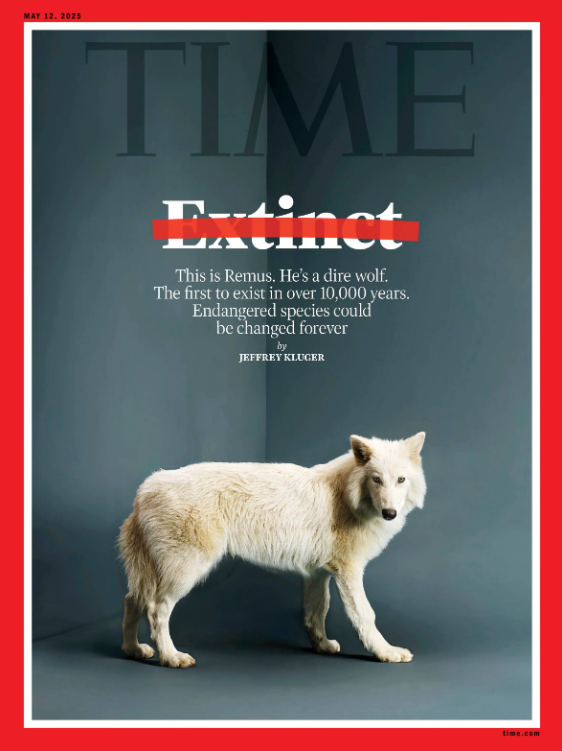
The company Colossal Biosciences has announced the birth of what they call three ‘dires wolves’, Romulus, Remus and Khaleesi, as reported in Time. The puppies, conceived in domestic dogs, were born thanks to genetic engineering techniques and ancient DNA to resemble a species that became extinct over 10,000 years ago.
Nic Rawlence - lobo colossal EN
Nic Rawlence
Director of the Otago Paleogenetics Laboratory and associate professor in the Zoology Department at the University of Otago (New Zealand)
To truly de-extinct something, you would have to clone it. The problem is we can't clone extinct animals because the DNA is not well enough preserved. Even if you sequence the genome, you can't extract DNA from extinct animals in long enough chunks like you could with a living animal. So the only way to "de-extinct" an animal is to use the new synthetic biology technology like CRISPR-cas9 where it acts like molecular scissors, and you can go and chop out a little bit of DNA and insert a new piece of DNA that effectively results in a genetic change.
So what Colossal Biosciences have produced is a gray wolf with dire wolf-like characteristics – this is not a de-extincted dire wolf, rather it’s a “hybrid”. And importantly, it's what they think are the important dire wolf-like characteristics. Dire wolves diverged from gray wolves anywhere between 2.5 to 6 million years ago. It's in a completely different genus to gray wolves. Colossal compared the genomes of the dire wolf and the gray wolf, and from about 19,000 genes, they determined that 20 changes in 14 genes gave them a dire wolf.
Another question – how's it going to learn to be a dire wolf? Currently, it's a wolf running around in a paddock. And does the ecosystem it once lived in still exist? It's the classic thing out of the first Jurassic Park movie, where the Triceratops get very sick because it was eating plants that hadn't actually evolved when it was around tens of millions of years ago. Can you also bring back enough animals for the population to not be genetically inbred…this is around 500 individuals, for the population not to suffer the consequences on inbreeding (think the Habsburgs).
In terms of indigenous perspectives on the dire wolf – Colossal have named their indigenous partners and thanked them. But given it's something this significant, it would have been really nice to actually hear from their indigenous partners. What is their viewpoint and what do they think about it? Are they really on board with this? Especially given my experiences of engaging with tangata whenua in Aotearoa New Zealand, where our iwi, hapu, rūnaga and trust partners are all dead set against de-extinction as it’s against tikanga.
But we need to be having these conversations and there needs to be community engagement. We need to have discussions around indigenous intellectual property, bio-prospecting, biopiracy, and what happens if animals are brought back from the dead and they are trademarked by these de-extinction companies?"
Personally, develop de-extinction technology but use it to conserve what we have left. Don’t bring back species from extinction.
Philip Seddon - lobo colossal EN
Philip Seddon
Professor in the Zoology Department at the University of Otago (New Zealand)
Dire Wolf De-extinction is not what it seems. Colossal Biosciences, the U$10B company behind efforts to resurrect the woolly mammoth, the Thylacine, and the dodo, have just announced what they describe as de-extinction of the dire wolf, a species that went extinct some 10,000 years ago. They are claiming this as the world's first de-extinction, but while no doubt it has required some amazing technological breakthroughs, the cute pups Romulus, Remus, and Khaleesi are not dire wolfs - they are genetically modified grey wolves.
Wolves and dire wolves, despite the wolf part of their names, are not closely related, having parted ways from a common ancestor some 6 million years ago, and the African jackal might be more closely related to dire wolves. Dire wolves are in their own genus, so a very different species. What Colossal has done is to introduce a small number of changes to the genetic material of a grey wolf to produce grey wolf pups with dire wolf features such as pale coats and potentially slightly larger size. So, hybrid grey wolves, or a GMO wolf. The pups will spend their days in a large enclosure being hand fed and closely monitored.
Certainly, this involves advances in genetic technology, and these might have applications for the conservation of existing species - but the return of dire wolves? No. In the same way that Colossal's plans for woolly mammoths and dodos will involve the genetic modification of related species. We have GMO wolves and might one day have GMO Asian elephants, but for now extinction really is forever.
Conflict of interest statement: Phil is a Professor of Zoology at the University of Otago. He has published on the bioethics and ecology of de-extinction and was the chair of an IUCN (World Conservation Union) Working Group that devised guiding principles on de-extinction for conservation.